UAE Driving Licence for Expats: Conversion, Tests, Salik, and Fines
Updated Sources RTA, UAE Government Portal
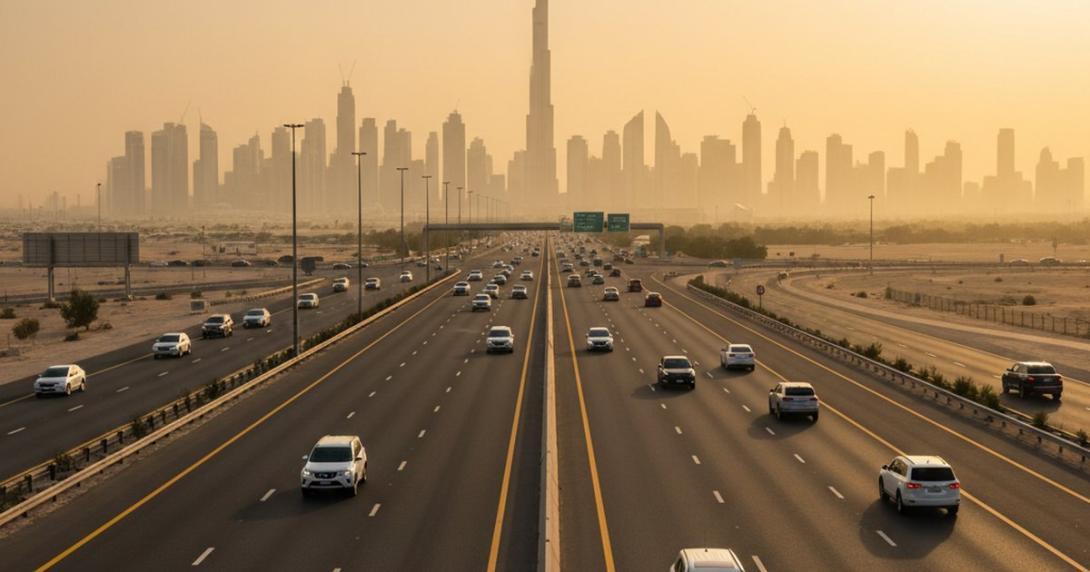
Driving is the default way to get around the UAE. Public transport is excellent in central Dubai but thins out fast everywhere else, and Abu Dhabi, Sharjah, and the smaller emirates are built for cars. For most expats, getting a UAE driving licence is one of the first things to sort out after the Emirates ID. The process splits into two paths: if your home country is on the UAE's auto-conversion list you can swap your existing licence for a UAE one without taking a test; if it isn't, you have to enrol in a driving school and pass full theory and practical exams. This guide covers both paths, the documents and fees, and the rules of the road once you're driving.
At a Glance
| Item | Detail |
|---|---|
| Authority | RTA (Dubai), Abu Dhabi Police via TAMM (Abu Dhabi), Ministry of Interior (other emirates) |
| Minimum age | 18 years |
| Conversion path | AED 1,050 in Dubai (RTA total, eye test included), eye test + paperwork, no driving test |
| Full course path | School packages vary widely by school; 6–10 weeks typical |
| Validity (new licences) | 2 years (1 year if under 21); 5 years once renewed, for residents 21 and over |
| Renewal fee | ~AED 320 (fees vary by emirate) |
| Black-point limit | 24 points → suspension |
Two Paths: Convert or Test
Whether you can convert your existing licence depends entirely on which country issued it. The UAE maintains an approved-countries list — if your home country is on it, the RTA (in Dubai) or Abu Dhabi Police (in Abu Dhabi) will swap your foreign licence for a UAE one with no driving test required. If your country is not on the list, you must enrol in an approved driving school, complete the lecture and practical hours, and pass the theory, parking, and road tests.
The list is updated periodically. As of the most recent expansion, the UAE recognises licences from over 50 countries, including all GCC states, the United Kingdom, Ireland, France, Germany, Italy, Spain, Netherlands, Belgium, Switzerland, Austria, Poland, Romania, all Nordic countries, the United States, Canada, Australia, New Zealand, Japan, South Korea, Hong Kong, China, South Africa, Turkey, and Albania. Singapore nationals can also exchange a Singapore licence in Dubai, but only after passing the RTA's knowledge test. The current list is maintained on the RTA website at rta.ae and on the Abu Dhabi Police portal — verify your country before booking anything else.
How to Convert Your Existing Licence
If your home country is on the approved list, the conversion is straightforward and can typically be completed in a single day.
Step 1 — Eye test. Visit an RTA-accredited eye-test centre, an RTA Customer Happiness Centre or a driving institute (in Dubai), or the centres approved in your emirate. The test is quick and costs AED 140–180 in Dubai, depending on the centre. Bring your Emirates ID and a passport-size photo. The result is sent to the licensing authority electronically.
Step 2 — Translate your home licence (if needed). If the RTA's country table (or your emirate's licensing authority) asks for a translation, have your licence translated by a legal translator accredited by the UAE Ministry of Justice. The translator sets the price, so ask for a quote.
Step 3 — Apply at the licensing authority. In Dubai, you apply on the RTA website and hand in your original licence at an RTA Customer Happiness Centre if your country's entry requires it. In Abu Dhabi, applications go through Abu Dhabi Police service centres or the TAMM platform. You submit your documents, pay the fee, and the new licence is issued the same day. Many licensing authorities now print the card on the spot.
Documents Required for Conversion
| Document | Notes |
|---|---|
| Original passport | With valid UAE residence visa |
| Emirates ID | Original card, must be active |
| Original home country driving licence | Must be valid (not expired) |
| Translation of home licence | If your country's entry in the RTA table requires one — legal translator accredited by the Ministry of Justice |
| Eye test certificate | From an approved optician — usually sent electronically |
| Passport-size photograph | White background |
| No-objection certificate (NOC) | Required from sponsor in some emirates and visa categories |
Conversion Fees
| Item | Cost in Dubai (AED, RTA) |
|---|---|
| Eye test | 140–180 |
| Translation of home licence (if needed) | Set by the translator |
| Traffic file | 200 |
| Licence issuance fee | 600 |
| Handbook manual + knowledge and innovation fees | 50 + 20 |
| Total — typical conversion | AED 1,050 on the RTA's list (it counts the eye test at AED 180), plus any translation |
If You Have to Take the Test
If your country is not on the auto-conversion list, you must register at one of the approved driving schools. In Dubai the main schools include Emirates Driving Institute (EDI), Belhasa Driving Centre, Al Ahli Driving School, Galadari Motor Driving Centre, and Dubai Driving Centre. In Abu Dhabi the main provider is Emirates Driving Company. You cannot legally take lessons or test through any other route — independent driving lessons are not recognised.
The course consists of:
- Registration and eye test — opens your file at the school
- Theory lectures — typically 8 classes covering UAE traffic rules and signage
- Practical lessons — usually 20–40 lessons depending on your driving history; previously licensed drivers from non-converting countries take fewer hours than first-time learners
- Theory test — computer-based (the RTA calls it the Knowledge Test)
- Parking / yard test — manoeuvres including parallel parking, garage parking, emergency stop
- Road test — final on-road examination conducted by the licensing authority
Total course cost varies widely with the school, the package and the number of lessons you need, and "VIP" packages with flexible scheduling cost more — compare each school's published package and ask what a failed test costs. Failing a test means re-paying for that test plus additional mandatory lessons before you can retake.
Realistic timeline for a first-time learner: 6–10 weeks. For someone who already drove abroad but holds a non-converting licence, 3–6 weeks is achievable.
After You Get Your Licence: Salik, Darb, Speed, and Black Points
UAE driving rules are strictly enforced and almost entirely automated through cameras, plate recognition, and electronic toll systems. There is essentially no on-the-spot interaction — fines arrive via SMS and accumulate against your traffic file.
Salik (Dubai tolls)
Salik is Dubai's automatic toll system. There are no booths: every vehicle needs a Salik tag on the windscreen, linked to a prepaid Salik account, and the gates read the tag as you pass and deduct the toll. Tolls are AED 6 at peak and AED 4 off-peak before VAT (the Salik app shows the amount charged); see Salik and Parkin for the hours. Top up via the Salik app, RTA app, or website. Failing to maintain a positive balance triggers a fine.
Darb (Abu Dhabi tolls)
Darb is Abu Dhabi's equivalent. It charges AED 4 per gate during peak hours (07:00–09:00 and 15:00–19:00, Monday to Saturday), and passage is free outside them, on Sundays and on official holidays, except at the two gates added on 4 May 2026 — Al Qurm, on Wahat Al Karama Street at Sheikh Zayed Street, and Ghantoot, on Sheikh Maktoum bin Rashid Street — which charge AED 4 a crossing 24 hours a day, seven days a week. Register and top up on the Darb site (darb.itc.gov.ae).
Speed limits and cameras
Speed limits are aggressively enforced by fixed and mobile cameras across the entire UAE road network. Highway limits are typically 100–120 km/h, and a few highways are posted higher — the sign is the limit. Do not count on a grace margin: the federal violations list fines any speed over the limit, starting at AED 300 for up to 20 km/h over.
Common fines
| Offence | Fine (AED) | Black points |
|---|---|---|
| Speeding up to 20 km/h over the limit | 300 | 0 |
| Speeding 20–30 km/h over limit | 600 | 0 |
| Speeding 60+ km/h over limit | 2,000 (3,000 above 80 km/h over) | 12 (23 above 80 km/h over) |
| Using mobile phone while driving | 800 | 4 |
| Not wearing seat belt | 400 | 4 |
| Running a red light | 1,000 | 12 |
| Tailgating | 400 | 4 |
| Reckless driving | 2,000 | 23 |
Black points
Black points stay on your record for one year from the date of the offence. Accumulating 24 black points within a 12-month window triggers a licence suspension — three months for a first suspension, six months for a second, and one year for a third, followed by a driving course, as Abu Dhabi Police set out the rule in 2013. Severe single offences (reckless driving, hit-and-run) can suspend your licence and impound your vehicle outright.
Paying fines
Fines are settled through the relevant emirate's police app or website — Dubai Police app, Abu Dhabi Police app, or moi.gov.ae for the northern emirates. Outstanding fines must be cleared before you can renew your licence, renew your vehicle registration, or sometimes before exiting the country.
Renewing Your UAE Driving Licence
A first UAE licence is valid for two years (one year if you are under 21); once renewed, it is valid for five years for residents aged 21 and over. Renewal is straightforward: have a valid eye test (AED 140–180 in Dubai; it stays valid for three years), clear your fines, pay the renewal fee (AED 300, plus AED 20 in knowledge and innovation fees in Dubai), and the RTA issues a Dubai licence instantly, as a digital licence, through its website or app; Abu Dhabi licences renew on TAMM and those of the other emirates through the MOI. If you are 21 or over you can renew up to six months before expiry (three months if younger), and in Dubai a late renewal costs AED 10 a month, up to AED 500. Driving on an expired licence costs AED 500, 4 black points and a 7-day impound for a light vehicle, and unless you renew within 30 days of an accident, the insurer can refuse your own claim and recover what it pays others from you.
Lost, Damaged, or Stolen Licence
Report a lost or stolen licence to the police, then apply for a replacement through the RTA app or your emirate's licensing authority. Replacement fees are around AED 300. A police report is usually required for a stolen licence.
Driving Before You Have a UAE Licence
Visitors with a GCC licence or one from the RTA's 20 "exception countries" (among them the UK, the US, most of western Europe, Japan and South Africa) can drive light vehicles in Dubai on it while on a visit visa — rental companies will check this at the desk. Once you become a UAE resident (i.e. you hold a residence visa), your home licence is no longer valid for driving in the UAE; you must convert it or take the test. Driving on a foreign licence as a resident is a fined violation (AED 400 on the federal list, and a court fine of AED 2,000–10,000 under Federal Decree-Law 14/2024, Art. 37, if the licence is from a country the UAE does not recognise), and the unified motor policy covers only drivers licensed under UAE traffic law, so the insurer can refuse your claim or recover its payout from you.
Part of the UAE Expat Guide — see the full series for the rest of the relocation sequence.
Frequently Asked Questions
Can I drive in the UAE on my foreign licence?
Visitors with a GCC licence or one from the RTA's 20 exception countries can drive light vehicles on it while on a visit visa. UAE residents (those holding a residence visa) cannot — once you have a residence visa, you must obtain a UAE driving licence either by conversion or by passing the test. Driving as a resident on a foreign licence is a fined violation, and the insurer can refuse your claim or recover its payout from you.
Which countries can convert their licence to a UAE one without a test?
The UAE recognises driving licences from over 50 countries, including all GCC states, the UK, Ireland, most EU countries (France, Germany, Italy, Spain, Netherlands, Poland, Romania, Nordic countries and others), the US, Canada, Australia, New Zealand, Japan, South Korea, Hong Kong, China, South Africa, Turkey, and Albania; Singapore nationals can exchange after a knowledge test. The current full list is published on the RTA website (rta.ae) and the Abu Dhabi Police portal.
How much does it cost to convert a foreign licence in the UAE?
In Dubai the RTA's fee list totals AED 1,050: traffic file AED 200, licence AED 600, handbook AED 50, eye test AED 180 (AED 140–180, depending on the centre) and AED 20 in knowledge and innovation fees, plus a legal translation if the RTA's table requires one (priced by the translator). Other emirates charge the same federal AED 600 licence fee plus their own fees.
How much does driving school cost in the UAE?
It varies widely by school, package and the number of lessons you need, and VIP or flexible packages cost more; compare each school's published package price. Failing a test adds extra fees plus mandatory additional lessons.
How long does it take to get a UAE driving licence?
Conversion can be completed in a single day if all documents are ready. The full driving school course typically takes 6–10 weeks for a first-time learner and 3–6 weeks for someone with prior driving experience from a non-converting country.
How long is a UAE driving licence valid?
A first licence is valid for two years (one year if you are under 21); a renewed licence is valid for five years for residents aged 21 and over. Renewal requires a valid eye test (it lasts three years), payment of the renewal fee (AED 300, plus AED 20 in Dubai), and clearing any outstanding fines.
What is Salik and how does it work?
Salik is Dubai's automatic toll system. Every vehicle needs a Salik tag on the windscreen, linked to a prepaid Salik account, and the gates read the tag as you pass and deduct the toll. Tolls are AED 6 at peak and AED 4 off-peak before VAT (the Salik app shows the amount charged). Top up through the Salik app, the RTA app, or salik.ae.
How many black points before my UAE licence is suspended?
Accumulating 24 black points within a 12-month period triggers a suspension — three months for a first suspension, six months for a second, and one year for a third, as Abu Dhabi Police set out the rule in 2013. Black points fall off your record one year after the date of the offence.
Do I need a no-objection letter to get a UAE driving licence?
Some emirates and visa categories require an NOC from your sponsor (employer or family sponsor). Dubai removed the routine NOC requirement for most categories, but it is still requested in certain cases. Check with your employer's PRO or the licensing authority before applying.
For the wider driving picture, see the full UAE driving and transport guide — getting a licence from scratch if your country is not on the conversion list, traffic fines and black points, Salik and Parkin rates, and Etihad Rail passenger trains.
Sources
The pages this guide is based on, official ones first, and when each was last checked against it.
-
RTA Exchanging a foreign licence in Dubai — the countries eligible, AED 200 traffic file, AED 600 licence, AED 50 handbook, AED 140–180 eye test and AED 20 fees (AED 1,050 in total), the translation table, the 1- or 2-year first licence, and who may drive on a visit visa
-
RTA Exchanging a Singapore licence — for Singapore nationals, after a knowledge test
-
RTA Renewing a licence — five years for residents aged 21 and over, renewal from six months before expiry, AED 300 plus AED 20 and the eye test, issued instantly online, the AED 10-a-month late fine up to AED 500, and suspension at 24 black points
-
UAE Government Portal Minimum ages (18 for cars), first and renewed licence validity, the age of 18 for an exchange, and a sponsor's letter only where the traffic department asks for one
-
Ministry of Interior The federal violations list (Ministerial Resolution 178/2017) — the speeding, phone, seat-belt, red-light, tailgating and reckless-driving fines and points, AED 500, 4 points and 7 days for an expired licence, and AED 400 for driving on a foreign licence outside permitted cases
-
Abu Dhabi Mobility Darb — AED 4 a crossing from 7 to 9 am and 3 to 7 pm, free on Sundays and official holidays, and the darb.itc.gov.ae account site
-
Abu Dhabi Mobility The Al Qurm and Ghantoot Darb gates, AED 4 a crossing 24 hours a day, seven days a week, from 4 May 2026
-
Abu Dhabi Police The 24-point rule — licence withdrawn for three months, then six months, then a year with a driving course (statement of 27 November 2013)
-
Sharjah Police Traffic points older than a year are erased if the limit was not reached
-
CBUAE The unified motor policy — cover only for a driver licensed under UAE traffic law, with an expired licence covered if renewed within 30 days of the accident
-
CBUAE The unified third-party policy — the insurer's right to recover what it paid others from a driver without a licence valid under UAE traffic law, or whose licence had expired and was not renewed within 30 days of the accident
-
Ministry of Justice Legal translators accredited by the Ministry
-
UAE Legislation Federal Decree-Law 14/2024, Art. 37 — a fine of AED 2,000 to 10,000 for a first offence of driving on a licence from a country the UAE does not recognise; read from the Wayback Machine's capture of 3 Aug 2025
-
UAE Legislation Cabinet Resolution 30/2017 — the federal AED 600 fee to replace a licence issued abroad, and AED 300 to renew or replace a licence of more than a year; read from the Wayback Machine's capture of 21 Apr 2025
-
Salik The windscreen tag linked to a prepaid account, and the fine when the balance runs out; read from the Wayback Machine's capture of 14 Sep 2025
-
Salik The variable toll rates of AED 6 at peak and AED 4 off-peak, before VAT; read from the Wayback Machine's capture of 14 Sep 2025
Spotted something out of date? Tell us, and we re-check it against the source.
General information based mainly on official public sources, not legal, immigration, tax, financial or medical advice. Rules and fees change: confirm with the relevant authority or a qualified professional before acting. See our Terms of Use.