Dubai vs Sharjah for Expats: Cost of Living, Commute, and Lifestyle Compared
Updated Sources Visit Sharjah, UAE Legislation
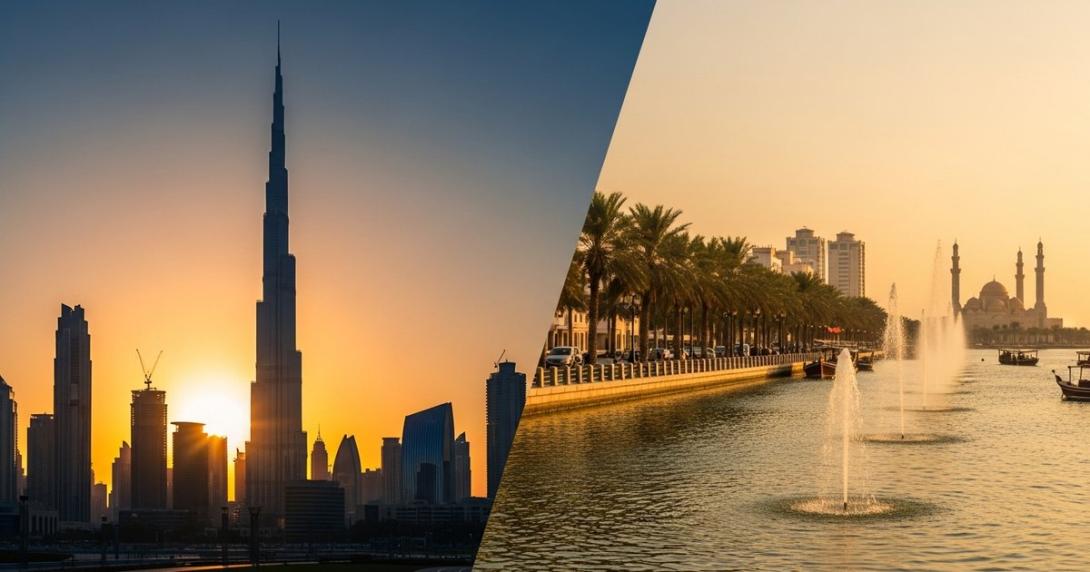
Dubai and Sharjah sit 15 kilometres apart but represent two very different ways to live in the UAE. Dubai is the UAE's most international city — expensive, liberal, and full of opportunity. Sharjah is quieter, significantly cheaper, and more conservative. Many expats live in Sharjah and commute to Dubai for work, trading a lower rent bill for one of the most congested commutes in the region. This guide covers the key differences across cost of living, commute, lifestyle, schools, and healthcare so you can make an informed decision about where to base yourself.
Dubai vs Sharjah at a Glance
Rents are average asking rents from Bayut's rental reports: Dubai's affordable and mid-tier areas in H1 2026, and Sharjah's popular areas in 2025.
| Factor | Dubai | Sharjah |
|---|---|---|
| 1-bedroom apartment (annual rent) | AED 56,000–104,000 | AED 37,000–43,000 |
| 2-bedroom apartment (annual rent) | AED 72,000–148,000 | AED 48,000–58,000 |
| Alcohol available | Yes — licensed venues and bottle shops | No — dry emirate |
| Rush-hour commute to Dubai CBD | Typically 15–30 min (within Dubai) | Typically 45–90 min |
| Metro access | Yes — Red and Green lines | No metro |
| Private schools | 233 (KHDA, 2025–26) | 136 (SPEA); fees often lower |
| Dress code | Relaxed in tourist and residential areas | More conservative; modest dress expected |
| Best for | Single professionals, nightlife, career focus | Families, budget-conscious expats |
Cost of Living: Rent
Rent is the single biggest factor driving expats to choose Sharjah over Dubai. In Bayut's 2025 Sharjah report, the average asking rent for a 1-bedroom apartment in well-located areas such as Al Nahda, Al Taawun and Al Khan was AED 37,000–38,000 a year. Its H1 2026 Dubai report puts the equivalent in Dubai's Al Nahda, International City and Deira at AED 56,000–66,000, and the gap widens in central areas such as Business Bay, where a 1-bedroom averaged AED 104,000.
For families needing a 2-bedroom apartment, Bayut's averages ran from AED 48,000 (Al Nahda) to AED 58,000 (Muwaileh) in Sharjah in 2025, against AED 72,000–109,000 in Dubai's affordable areas and AED 113,000–148,000 in its mid-tier areas (JVC, Arjan and Business Bay) in H1 2026. The table sets out Bayut's averages by unit type.
| Apartment type | Sharjah (annual, 2025) | Dubai — affordable areas (annual, H1 2026) | Dubai — mid-tier areas (annual, H1 2026) |
|---|---|---|---|
| Studio | AED 26,000–34,000 | AED 40,000–44,000 | AED 53,000–73,000 |
| 1 bedroom | AED 37,000–43,000 | AED 56,000–66,000 | AED 79,000–104,000 |
| 2 bedrooms | AED 48,000–58,000 | AED 72,000–109,000 | AED 113,000–148,000 |
Sharjah apartments also tend to be larger for the same price point — older mid-rise buildings in Al Nahda and Al Taawun offer spacious layouts that would cost considerably more in Dubai.
Cost of Living: Groceries, Utilities, and Transport
Outside of rent, day-to-day costs are broadly similar across both emirates. Supermarket prices at Carrefour, Lulu, and Spinneys are consistent regardless of whether the branch is in Dubai or Sharjah. Utility bills (DEWA in Dubai, SEWA in Sharjah) are comparable for similar-sized apartments. Fuel prices are set nationally and are identical across all emirates.
Where costs diverge is in dining and entertainment. Dubai has a wider range of licensed restaurants and bars, and premium dining and nightlife carry a significant premium. Sharjah's food and beverage scene is entirely non-alcoholic, which removes the cost of licensed venues but also removes the option entirely for expats who drink.
The Dubai–Sharjah Commute
Al Ittihad Road (E11) and Al Wahda Street are two of the main routes. During rush hours — roughly 7:00 to 9:30 am inbound and 5:00 to 8:00 pm outbound — a journey that takes 15–20 minutes at off-peak can stretch to 60–90 minutes or more.
This commute is the defining trade-off of the Sharjah option. A family that saves on rent by living in Sharjah may find that saving offset by the real cost of the commute: fuel, vehicle wear, and — hardest to quantify — 1.5 to 3 hours of daily commuting time.
Key commute facts:
- Off-peak travel time: approximately 20 minutes by car
- Peak-hour travel time: 45–90 minutes by car, sometimes longer
- Public bus: RTA's intercity buses link the two emirates. Its September 2020 announcement lists route E303 from Union Metro Station and E307A from Abu Hail Metro Station to Sharjah's Al Jubail bus station, and both are on RTA's current list of operating intercity routes. Journey times depend on traffic, plus any metro leg
- No metro in Sharjah — public transport into Dubai runs by bus, or by RTA's FR5 ferry between Sharjah Aquarium and Al Ghubaiba marine stations
- Carpooling is common among expats commuting along this corridor
If your workplace is in Deira, Al Qusais, or other parts of eastern Dubai, the Sharjah commute is manageable. If your office is in Dubai Marina, JLT, or the Dubai CBD, add the metro or another 20–30 minutes by car to the journey time above.
Lifestyle: Alcohol, Entertainment, and Culture
Sharjah is a dry emirate: no alcohol is sold or served anywhere, not even in hotels, and there are no licensed restaurants, bars or bottle shops. Federal law permits drinking or possessing alcohol only "in the cases and at places authorized" by the legislation in force, and each emirate sets its own rules: possessing or bringing in alcohol outside them is punishable by imprisonment and/or a fine, and drinking it in a public place or anywhere else not authorised by up to six months' imprisonment and/or a fine, and the court may also order a foreign offender's deportation (Federal Decree-Law No. 31 of 2021, Article 363). Do not bring alcohol into Sharjah, even to drink at home.
Dubai, by contrast, has a large number of licensed hotels, restaurants, and bars, and licensed shops sell alcohol under Dubai's own rules; selling or serving alcohol to anyone under 21 is a crime under federal law. This is a significant lifestyle factor for expats who drink socially — the absence of the option entirely is one of the most common reasons expats choose Dubai over Sharjah despite the higher cost.
Sharjah compensates with a strong arts and cultural offer. The emirate is a UNESCO Creative City of Crafts and Folk Art, was UNESCO's World Book Capital in 2019, and is home to the Sharjah Art Foundation, the Sharjah Museum of Islamic Civilization, and a cluster of museums around the Heritage Area. The Al Majaz Waterfront and Khalid Lagoon Corniche are popular recreational areas. For families who prioritise culture, green space, and a quieter pace of life over nightlife, Sharjah has genuine appeal.
Schools and Education
Both Dubai and Sharjah have strong international school options covering British, American, Indian (CBSE), and IB curricula. Dubai had 233 private schools in 2025–26, regulated by the KHDA (Knowledge and Human Development Authority). Sharjah's private schools are regulated by the SPEA (Sharjah Private Education Authority), whose directory lists 136 schools.
School fees in Sharjah are often lower than at equivalent-quality schools in Dubai, but fees vary widely by school and curriculum in both emirates, so compare the schools you are considering. The saving per child can be significant for families with multiple children.
Many Sharjah-based families send children to schools in Dubai, which is feasible given the proximity, though it adds to the family's daily commute burden. School buses operate cross-emirate routes and are a common option.
Healthcare
Dubai and Sharjah both have good private healthcare infrastructure. Dubai's health system is regulated by the Dubai Health Authority (DHA) and is home to a high concentration of private hospitals, clinics, and specialist centres including Mediclinic and American Hospital Dubai. Sharjah's healthcare is regulated by the Sharjah Health Authority and has a smaller but functional network of private hospitals, with Zulekha Hospital and University Hospital Sharjah among the main options.
Health insurance is mandatory for all employees in Dubai under DHA regulations. In Sharjah, since 1 January 2025 employers must buy health insurance before a private-sector employee's or domestic worker's residence permit is issued or renewed. In practice, most UAE employers across both emirates provide group health insurance as part of the standard employment package.
For specialist care or complex procedures, most expats in both emirates access facilities in Dubai — the concentration of internationally trained specialists and internationally accredited hospitals is higher there.
Which is Right for You?
Choose Dubai if: you are a single professional or couple without children, value lifestyle flexibility including dining and nightlife, want metro access and shorter commutes, or are not under significant budget pressure on rent.
Choose Sharjah if: you are a family with children and the rent saving is material to your budget, you are comfortable with a dry emirate, your workplace is in eastern Dubai or Deira where the commute is shorter, or you value space, quieter surroundings, and proximity to Sharjah's cultural offer.
The hybrid option: Many expats live in Sharjah while working in Dubai, particularly families at mid-range salary levels where the rent saving justifies the commute. The key variable is the commute tolerance — the same commute feels very different to someone driving 45 minutes from Al Taawun to Deira versus someone spending 90 minutes each way on a bus to Dubai Marina.
Part of the UAE Expat Guide — see the full series for the rest of the relocation sequence.
Frequently Asked Questions
Is it cheaper to live in Sharjah than Dubai?
Yes, significantly, for rent. In Bayut's reports, a 1-bedroom apartment averaged AED 37,000–43,000 a year in asking rent in Sharjah's popular areas in 2025, against AED 56,000–104,000 in Dubai's affordable and mid-tier areas in H1 2026. Day-to-day costs for groceries and utilities are broadly similar across both emirates.
How long is the commute from Sharjah to Dubai?
Off-peak, the drive from central Sharjah to eastern Dubai takes around 20 minutes. During morning rush hour (7:00–9:30 am) and evening rush hour (5:00–8:00 pm), the same journey commonly takes 60–90 minutes by car. The Dubai–Sharjah highway (Al Ittihad Road / E11) is one of the busiest roads in the UAE.
Can you buy alcohol in Sharjah?
No. Sharjah is a dry emirate: no alcohol is sold or served anywhere, not even in hotels, and there are no licensed restaurants, bars or bottle shops. Federal law allows drinking or possessing alcohol only in the cases and places each emirate's rules authorise and punishes possessing or drinking it otherwise, and a court may order a foreign offender's deportation (Federal Decree-Law No. 31 of 2021, Article 363), so do not bring alcohol into Sharjah, even to drink at home.
Can I live in Sharjah and work in Dubai?
Yes — and it is very common. Your UAE residence visa is issued based on your employer's emirate, but you can live anywhere in the UAE. If your visa is issued in Dubai and you will sponsor your family, GDRFA Dubai asks for an attested Ejari lease or a Dubai Land Department title deed to open the sponsor file, so settle how your family's visas will be handled before you sign a Sharjah lease. Many expats commute daily from Sharjah to Dubai for work. The key consideration is whether the commute time suits your work schedule and lifestyle.
Is Sharjah safe for expats?
Yes. The emirate is known for being family-friendly and conservative. The main practical concern is road safety on the congested Dubai–Sharjah highway at rush hour.
Are there international schools in Sharjah?
Yes — SPEA's directory lists 136 private schools in Sharjah, with curricula including British, American, Indian and IB. School fees are often lower than at equivalent schools in Dubai, but compare the schools you are considering. Many Sharjah-based families also choose schools in Dubai, with cross-emirate school bus services widely available.
What is the difference in lifestyle between Dubai and Sharjah?
Dubai is more cosmopolitan, with licensed bars and restaurants, beach clubs, and an international nightlife scene. Sharjah is more conservative — it is a dry emirate with no alcohol, stricter dress codes in public, and a stronger emphasis on arts, culture, and family-oriented leisure. Sharjah is a UNESCO Creative City of Crafts and Folk Art and has a strong museum and waterfront scene.
Sources
The pages this guide is based on, official ones first, and when each was last checked against it.
-
Visit Sharjah The food guide on the Sharjah Commerce and Tourism Development Authority's visitor site, written for it by Lonely Planet — Sharjah is a dry emirate where no alcohol is available anywhere, not even in hotels
-
UAE Legislation Federal Decree-Law No. 31 of 2021 (the Crimes and Penalties Law), Article 363 — alcohol is lawful only in the cases and places each emirate authorises, the penalties for possessing it otherwise and for drinking it in a public place or anywhere else not authorised, the ban on selling or serving it to anyone under 21, and the court's power to deport a foreign offender; read from the Wayback Machine's capture of 2 Mar 2026
-
UAE Government Portal Health insurance — Dubai employers must insure their employees, and since 1 January 2025 employers must buy cover before a private-sector employee's or domestic worker's residence permit is issued or renewed
-
RTA The Metro's Red and Green lines, the intercity bus routes RTA lists as operating, and the FR5 ferry between Sharjah Aquarium and Al Ghubaiba
-
RTA Routes E303 from Union Metro Station and E307A from Abu Hail Metro Station to Sharjah's Al Jubail bus station, as announced in September 2020
-
KHDA Dubai's 233 private schools for 2025–26
-
SPEA Sharjah's directory of 136 private schools and the curricula it lists, including British, American, Indian and IB
-
GDRFA Dubai Sponsor file registration — an attested Ejari lease or a Dubai Land Department title deed
-
UNESCO Sharjah as World Book Capital 2019 and a Creative City of Crafts and Folk Art
-
Bayut (market data) Dubai Rental Market Report H1 2026 — average asking rents for studios and 1- and 2-bedroom apartments in Al Nahda, Deira, International City, JVC, Arjan and Business Bay
-
Bayut (market data) Annual Sharjah Market Report 2025 — average asking rents for studios and 1- and 2-bedroom apartments in Muwaileh, Al Majaz, Al Nahda, Al Taawun and Al Khan
Spotted something out of date? Tell us, and we re-check it against the source.
General information based mainly on official public sources, not legal, immigration, tax, financial or medical advice. Rules and fees change: confirm with the relevant authority or a qualified professional before acting. See our Terms of Use.