الإمارات العربية المتحدة
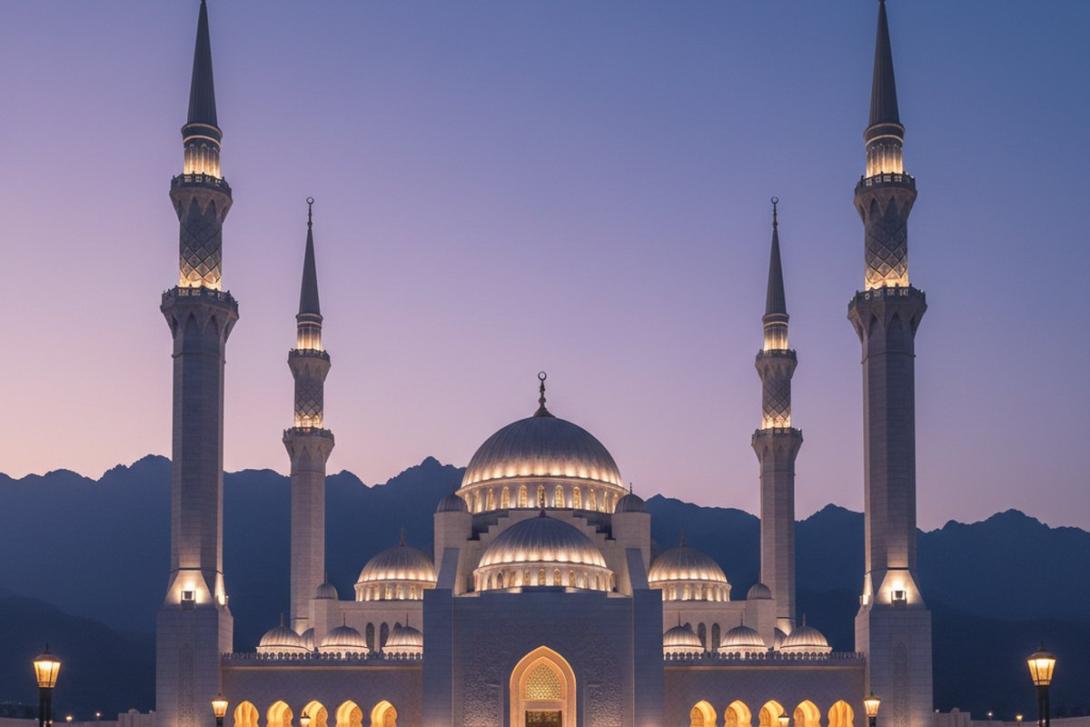
Sheikh Zayed Mosque Fujairah is the central mosque of Fujairah emirate and the second-largest mosque in the UAE after the Sheikh Zayed Grand Mosque in Abu Dhabi. One of several mosques named in honour of the late Sheikh Zayed bin Sultan Al Nahyan, it is by far the largest of the regional tributes — the only one to approach the Abu Dhabi original's scale. Inaugurated in 2015, it sits in the Sakamkam district on the northern edge of Fujairah city, six minarets rising around 100 metres above the low-rise neighbourhood. Entry is free, non-Muslims are welcome outside prayer times, and it is the natural cultural anchor of any Fujairah day trip.
At a Glance
| Field | Value |
|---|---|
| Location | Sakamkam district, Fujairah city |
| Inaugurated | 2015 |
| Capacity | Approximately 28,000 worshippers (some sources up to 32,000) |
| Domes | Multiple — central dome with surrounding smaller domes; widely cited at around 65 in total |
| Minarets | 6 minarets, each rising approximately 100 metres |
| Hours | Approximately 9 a.m. – 12 p.m. and 4 p.m. – 9 p.m. for non-Muslim visitors; closed during the five daily prayers |
| Admission | Free |
| Dress code | Modest — covered shoulders, knees, arms; women cover their hair |
| Distance from Fujairah Corniche | ~5–10 minutes by car |
| Distance from Dubai | ~125 km / 90 minutes via E311 and Sheikh Khalifa Highway (E84) |
| Best for | Heritage travellers, photographers, Fujairah day-trippers, anyone interested in the regional Sheikh Zayed mosques |
The Architecture
The mosque is built in a modern Arab-Islamic idiom rather than reproducing a single regional tradition. The exterior is clad in white and beige stone, warming through the day as the sun moves over the Hajar Mountains. The footprint is rectangular, with an open courtyard wrapping the main prayer hall and a perimeter colonnade providing shade.
The Six Minarets
The six minarets are the building's signature. Most large mosques in the region settle on four, so a six-minaret arrangement marks Fujairah's mosque as architecturally distinct. They rise to roughly 100 metres each and are visible from kilometres away on the approach across the mountains.
The Domes
A large central dome sits over the main prayer hall, stepped down by clusters of smaller domes covering the side aisles, entrances, and ablution wings. The widely cited total is around 65 domes, although exact counts vary between sources. By day the shells read as pure white against the desert sky; at night uplighting picks them out against the mountains behind.
The Interior
Marble floors are inset with floral mosaic patterns in coloured stone, the central prayer area opening up under the main dome. A large central chandelier hangs from the dome's apex, and the walls carry layered Islamic geometric patterning and Quranic calligraphy in panels around the prayer hall. The detailing is more restrained than the maximalist scale of the Abu Dhabi original — the building reads as a working congregational mosque first and a tourist attraction second.
The Courtyard
The open courtyard between the perimeter wall and the main building absorbs overflow worshippers on Fridays and during Eid prayers, pushing the headline capacity towards 28,000 — and, on some accounts, towards 32,000 with full courtyard use. Outside Friday and Ramadan it is quiet and walkable, and the perimeter is the best vantage for exterior photography.
Visitor Experience
Most visitors spend 45 minutes to 1.5 hours here, longer if you time the visit for sunset and stay through the lighting transition.
Dress Code
Modest dress is required for everyone, and rules are similar to those at other large UAE mosques. Long trousers or a long skirt covering the ankles, sleeves to the wrists, and a head covering for women are required. Tight or sheer clothing is not permitted. Free abayas and kanduras are provided at the visitor entrance — bring your own scarf if you prefer. Shoes are removed before entering the prayer hall.
Photography
Personal photography is allowed inside and out. No flash inside the prayer hall, no tripods without prior permission, and no photographing worshippers during prayer. Drones are not permitted. The cleanest exterior shots are from the eastern approach in late afternoon, with the six minarets aligned against the mountains; the courtyard arches frame the central dome from any angle.
Sunset and Blue Hour
The exterior is at its most photogenic in the half-hour around sunset and through the blue hour that follows. The white-and-beige stone shifts to warm gold during the sunset itself, then uplighting picks out the minarets and dome shells against the deepening blue sky behind the Hajar Mountains. Arrive an hour before sunset to walk the courtyards in daylight before the lights come up.
Distinguishing It from the Abu Dhabi Grand Mosque
This is the most common point of confusion for first-time visitors: several mosques named for Sheikh Zayed exist across the UAE, and they are distinct buildings rather than one landmark with multiple sites.
The Sheikh Zayed Grand Mosque in Abu Dhabi is the largest and most famous — a 12-hectare white-marble complex with 82 domes, four 107-metre minarets, the world's largest hand-knotted carpet, and capacity for around 40,000 worshippers. Opened in 2007, it was the personal vision of Sheikh Zayed bin Sultan Al Nahyan, who is buried on the grounds.
Sheikh Zayed Mosque Fujairah is a separate building, inaugurated in 2015, and is the second-largest mosque in the UAE at around 28,000 capacity. It is Fujairah's own emirate-level tribute and the only regional Sheikh Zayed mosque to approach the original's scale. The Sheikh Zayed Mosque in Ajman is a third, smaller building — opened in 2018 with capacity for around 6,500 worshippers. Visiting all three in sequence gives a clear read on the spread of tributes from national-monument scale to neighbourhood scale.
Getting There
By Car
The mosque sits in the Sakamkam district on the northern edge of Fujairah city, near the start of the road heading north towards Khor Fakkan and Al Aqah. From the Fujairah Corniche it is a 5- to 10-minute drive; from Fujairah Fort around 10 minutes. Free parking is available on the mosque grounds, with separate lots and entrances signed for visitors.
From Dubai
Take Sheikh Mohammed bin Zayed Road (E311) to Sheikh Khalifa Highway (E84), then east through the Hajar Mountains into Fujairah city — approximately 125 km, around 90 minutes outside peak hours. The mountain crossing is one of the more scenic inter-emirate drives in the country, and the mosque's six minarets are usually the first landmark you see on the descent.
By Taxi or Public Bus
A taxi within Fujairah city to the mosque is short and inexpensive. From Dubai, a one-way ride-hail typically runs AED 250–350; at that level, self-drive is far more economical. Inter-emirate buses run from Dubai to Fujairah central bus station, with a short local taxi from there to the mosque — around three hours each way in total.
Best Time to Visit
- November to March — peak season. Daytime temperatures of 18–28 °C make the open courtyards comfortable. Friday mornings are restricted; weekday late afternoons are quietest.
- April and October — workable, but the courtyard heats up midday. Aim for after 4 p.m.
- May to September — daytime visits are uncomfortable on the open courtyard. Aim for after 6 p.m. and accept higher humidity.
- Friday — non-prayer access is restricted on Friday afternoons; mornings are usually fine.
- Ramadan — visiting hours shift, and the courtyard atmosphere around iftar is particularly worth experiencing. Confirm hours before travelling.
Practical Notes
- Entry is free; no booking required
- Modest dress is required; abayas and kanduras are provided free at the visitor entrance
- Shoes are removed before entering the prayer hall
- Closed to non-Muslim visitors during each of the five daily prayers and on Friday afternoons
- Photography is allowed inside and out; no flash, no tripods, no photographing worshippers
- Drones are not permitted
- Free parking on the mosque grounds
- Allow 45 minutes to 1.5 hours; longer if you stay for sunset
- Combine with a Fujairah day trip — fort, corniche, and east-coast beach all within easy reach
- Hours, prayer-time pauses, and Ramadan timings can shift; confirm locally on the day
Nearby
The mosque is the natural anchor for a Fujairah day trip. Fujairah Fort is around 10 minutes south in the city, paired with the Fujairah Heritage Village beside it. The Fujairah Corniche is 5 to 10 minutes away for a walk along the Gulf of Oman. Heading north up the east coast, Al Bidya Mosque — the oldest known mosque in the UAE, dated to around 1446 AD — is roughly 35 minutes away, and the visit pairs Fujairah's largest mosque with the country's smallest and oldest in a single afternoon. Snoopy Island and the Al Aqah resort cluster sit just beyond for a beach finish; Khor Fakkan is about 30 minutes north.
Frequently Asked Questions
What is Sheikh Zayed Mosque Fujairah?
It is the central mosque of Fujairah emirate and the second-largest mosque in the UAE by capacity, after the Sheikh Zayed Grand Mosque in Abu Dhabi. It sits in the Sakamkam district of Fujairah city, was inaugurated in 2015, and holds around 28,000 worshippers. It is one of several mosques across the country named in honour of the late Sheikh Zayed bin Sultan Al Nahyan.
Is this the same as Sheikh Zayed Grand Mosque in Abu Dhabi?
No — they are different buildings in different emirates. The Sheikh Zayed Grand Mosque in Abu Dhabi is the country's largest mosque, with 82 domes, four minarets, and capacity for around 40,000 worshippers, opened in 2007. Sheikh Zayed Mosque Fujairah is a separate, smaller building inaugurated in 2015 with capacity for around 28,000. Both honour the same ruler.
How does it compare to the Sheikh Zayed Mosque in Ajman?
The Sheikh Zayed Mosque in Ajman opened in 2018 with capacity for around 6,500 — a regional-scale mosque sized for its emirate. Fujairah's is several times larger and the only regional Sheikh Zayed mosque to approach the Abu Dhabi original's scale.
Is it free to visit?
Yes. Entry is free for all visitors, including non-Muslims on cultural visits outside the five daily prayers.
What are the opening hours?
Approximately 9 a.m. to 12 p.m. and 4 p.m. to 9 p.m. for non-Muslim visitors, with the mosque closed during each of the five daily prayers. Friday afternoons are reserved for congregational prayer. Hours shift during Ramadan; confirm locally before travelling.
Can non-Muslims visit Sheikh Zayed Mosque Fujairah?
Yes, outside the five daily prayers and outside Friday afternoons. Modest dress is required for everyone, and abayas and kanduras are provided free at the visitor entrance for those without compliant clothing.
What is the dress code?
Long trousers or a long skirt covering the ankles, sleeves to the wrists, and a head covering for women. Tight or sheer clothing is not permitted. Free abayas and kanduras are available at the visitor entrance.
How do I get there from Dubai?
Drive Sheikh Mohammed bin Zayed Road (E311) to Sheikh Khalifa Highway (E84), then continue east through the Hajar Mountains into Fujairah city — approximately 125 km, around 90 minutes outside peak hours. Free parking sits on the mosque grounds.
When is the best time to visit for photography?
The half-hour around sunset and the blue hour that follows. The stone warms through golden hour, then exterior uplighting picks out the six minarets and dome shells against the deep blue sky behind the Hajar Mountains.
How many minarets does it have?
Six, each rising approximately 100 metres — the building's most distinctive feature. Most large mosques in the region settle on four, including the Abu Dhabi Grand Mosque.