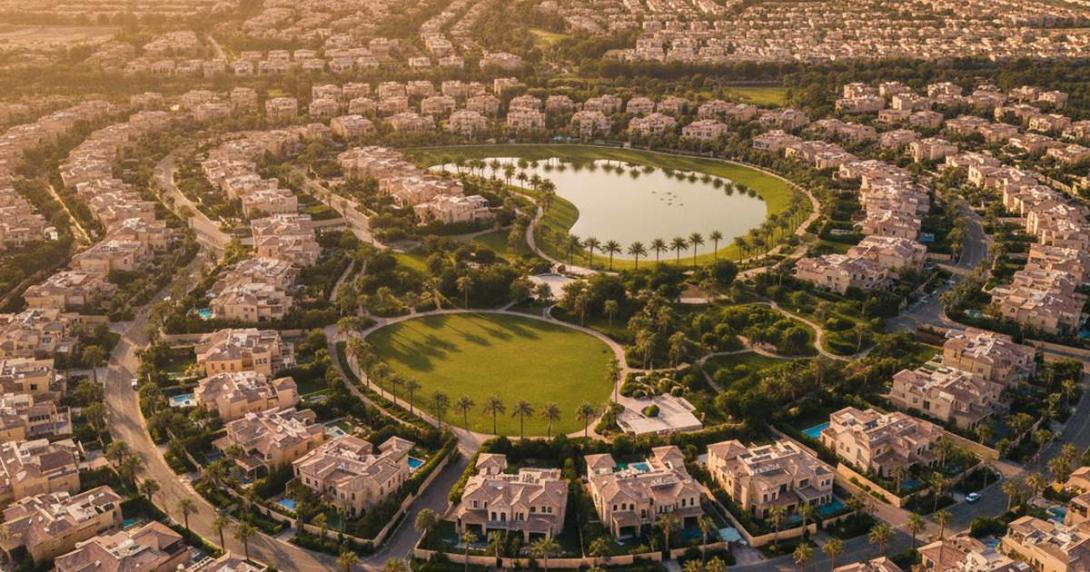
For expat families relocating to Dubai, neighbourhood choice is rarely a lifestyle question — it is a three-way trade-off between rent, school access, and commute, decided by salary tier and where the children sit in the school cycle. The villa belt around Dubai Hills Estate and Arabian Ranches sits at one end; affordable townhouse communities like Mira, Town Square, and Al Furjan sit at the other, with apartment-led pockets such as JVC, JLT, and the Greens stitching the middle. School zoning is informal — there is no UK-style catchment — but the practical bus-route radius around major British, American, and IB schools concentrates families into recognisable clusters. This guide maps the main family neighbourhoods, the rent each commands for a 3-bed unit, the schools that anchor them, and the rush-hour commute to DIFC and Downtown. See also the Family in the UAE hub, Schools in the UAE, Schooling fees, Renting in Dubai, Cost of Living, and the parallel Family neighbourhoods in Abu Dhabi guide.
At a Glance
| Neighbourhood | Type | 3-bed rent (AED/year) | Top schools | Notable parks / amenities | Commute to DIFC |
|---|---|---|---|---|---|
| Dubai Hills Estate | Villa community | 230,000-380,000 | GEMS Wellington Academy, Dubai Hills; GEMS International | Dubai Hills Park (180,000 m2), Dubai Hills Mall | 15-25 min |
| Arabian Ranches (1-3) | Villa community | 200,000-340,000 | JESS Arabian Ranches, Ranches Primary, Ranches Secondary | Multiple central parks, Ranches Souk | 25-35 min |
| Mira (Reem) | Townhouse | 130,000-200,000 | Ranches Secondary, Fairgreen, Repton Al Barsha (bus) | Mira Park, Reem Community Centre | 30-40 min |
| Tilal Al Ghaf | Premium villa / lagoon | 350,000-700,000+ | Royal Grammar School Guildford Dubai (nearby) | Recreational lagoon, central park | 25-35 min |
| Al Furjan | Villa / townhouse / apartment | 130,000-200,000 | Arbor School, The Arbor (bus) | Community parks, Al Furjan Pavilion | 25-30 min |
| JVC | Apartment + villa pockets | 140,000-200,000 | JSS International, Sunmarke, Nord Anglia (bus) | Multiple community parks, Circle Mall | 20-30 min |
| Town Square | Townhouse | 130,000-180,000 | Fairgreen, Jebel Ali School (bus) | Town Square Park, splash pads | 35-45 min |
| The Sustainable City | Eco-villa community | 230,000-300,000 (4-bed) | Fairgreen International (on-site) | Car-free streets, urban farm, green spine | 30-40 min |
| Mirdif | Older villa suburb | 130,000-180,000 | Uptown School, Star International, GEMS Royal Dubai | Mirdif Park, Mirdif Hills, City Centre Mirdif | 25-35 min |
| Al Barsha | Apartment / older villa | 110,000-160,000 (apt) | American School of Dubai, GEMS New Millennium | Mall of the Emirates, Al Barsha Pond Park | 20-30 min |
| JLT | Apartment | 150,000-220,000 | No on-site primary; bus to Marina/Greens schools | JLT lake parks, metro, Dubai Marina | 15-25 min |
| Greens / Views | Mid-rise apartment | 130,000-200,000 | Emirates International School Meadows, Dubai British (bus) | Lakes, mature landscaping | 15-20 min |
Use these as bands rather than headline numbers — Dubai rents move quickly with handover cycles and Ejari-renewal index ceilings, and quoted figures shift each leasing season.
Established Villa Communities
The historic family-villa belt sits south of Sheikh Zayed Road, on the Al Qudra and Umm Suqeim road corridors. These are master-planned, gated communities, generally Emaar-built, dense with schools, and the default for senior-tier expat families willing to pay AED 200,000-400,000 a year for a 3-bed villa with garden and pool access.
Dubai Hills Estate
Dubai Hills Estate is the post-2018 flagship of the family-villa segment — Emaar-built, anchored by an 18-hole championship golf course, Dubai Hills Mall (opened 2022), and the 180,000 m2 Dubai Hills Park. The schooling cluster is exceptional: GEMS Wellington Academy Dubai Hills (UK curriculum, primary through Year 13), GEMS International School (IB, K-12), with several other British and American options on bus routes from Al Khail and Hessa Street. 3-bed villa rents typically run AED 230,000-380,000/year depending on sub-community (Maple, Sidra, Park Heights for apartments). The DIFC commute is the best of any villa community at 15-25 minutes off-peak, accessed via Al Khail Road. Premium positioning, premium price, but the school-park-mall-commute combination is hard to match.
Arabian Ranches (1, 2, 3)
The original Emaar villa community, opened in stages from 2004 onwards, with phase 3 still completing handovers. Arabian Ranches is the established choice — mature landscaping, multiple central parks, the Ranches Souk with restaurants and grocery, and three on-site schools: JESS Arabian Ranches (UK curriculum, primary), Ranches Primary School, and Ranches Secondary School. The community sits on Sheikh Mohammed Bin Zayed Road / Emirates Road, putting it 25-35 minutes from DIFC in rush hour. 3-bed villas rent at AED 200,000-340,000/year, with phase 1 (older, larger plots) typically commanding the upper end and phase 3 still calibrating. The character is suburban-British — golf, equestrian, school-run-and-coffee — and turnover is low because families stay through the full school cycle.
Tilal Al Ghaf
Tilal Al Ghaf is the post-2020 luxury entrant from Majid Al Futtaim, built around a recreational lagoon with white sand beaches, a central family park, and a master plan oriented around active recreation. Villas are larger and pricier than the Emaar comparables — 3- and 4-bed units start around AED 350,000/year and run well beyond AED 700,000 for the lagoon-fronting Lanai and Elysian Mansions sub-communities. On-site schooling is still developing, with the Royal Grammar School Guildford Dubai branch close by. Commute to DIFC is 25-35 minutes. Best for executive-tier families prioritising newer-build infrastructure and the lagoon amenity over the proven school density of Dubai Hills or Arabian Ranches.
New Family-Focused Developments
A second tier of newer master-planned communities, calibrated below the executive villa segment, has reshaped where mid-budget and dual-income families settle. The shift is from villa to townhouse — smaller plots, shared walls, no private pool, but rent at half the established-villa level.
Mira (Reem)
Mira, also marketed as the Reem Community, is Emaar's townhouse answer to the Ranches villa price ceiling. Set off the Al Qudra Road corridor, it gathers four phases of three- and four-bed townhouses around Mira Park and the Reem Community Centre. There is no on-site secondary school — Ranches Secondary, JESS Arabian Ranches, and Fairgreen International are the closest options, all on bus routes. 3-bed townhouses rent at AED 130,000-200,000/year, with phase 4 (newest, smallest plots) at the lower end. DIFC commute is 30-40 minutes in rush hour via Sheikh Mohammed Bin Zayed Road. The community attracts dual-income mid-tier expat families that want a garden and a community feel without Ranches-level rent.
Town Square
Town Square is Nshama's bid for the affordable family townhouse market — further out, off Al Qudra Road past Arabian Ranches, with a long phase-by-phase rollout (Hayat, Naseem, Zahra, Safi, Warda, etc.). The community is built around a large central park with splash pads, kid-zones, jogging tracks, and a community pool, with Carrefour-anchored retail. Schools sit just outside the community — Fairgreen International (IB) and Jebel Ali School (UK) on bus routes. 3-bed townhouses rent at AED 130,000-180,000/year — among the lowest in the family-townhouse segment. The trade-off is commute: 35-45 minutes to DIFC in rush hour, sometimes longer in winter when school buses queue out of the community. Best for mid-tier families willing to absorb the drive in exchange for material rent savings.
The Sustainable City
The Sustainable City is the niche eco-development on Al Qudra Road, planned around car-free residential streets (cars park on the perimeter), solar-panelled villas, an urban farm, and a green spine. Fairgreen International School (IB, on-site) is a substantial draw — many families pick the community for the school-at-walking-distance proposition alone. 4-bed villas rent at AED 230,000-300,000/year, with a smaller pool of 3-bed units. Commute to DIFC is 30-40 minutes. Character is values-led — community ESG culture, low-traffic streets safe for kids cycling, electric-buggy school runs — and turnover among existing tenants is unusually low.
Mid-Budget Townhouse and Apartment Communities
Below the master-planned villa segment, a cluster of mid-budget communities offers the rent profile that suits junior to mid-career families on AED 25,000-40,000/month total household income.
Al Furjan
Al Furjan is a Nakheel-built community west of Sheikh Zayed Road, mixing villas, townhouses, and apartment blocks across several phases. Two metro stations — Discovery Gardens and Al Furjan on the Red Line — give it the rare advantage of metro-accessible family housing, useful for one-car households. School options include Arbor School (IB, on-site) and The Arbor School primary. 3-bed townhouses rent at AED 130,000-200,000/year; villa pricing runs higher. Commute to DIFC is 25-30 minutes by car or 35-40 minutes by metro. Character is more suburban than the established Emaar communities — fewer central parks, more retail-led pavilions — but the metro access is genuinely differentiating.
JVC (Jumeirah Village Circle)
JVC is apartment-heavy with pockets of villas and townhouses, organised in a circular master plan off Sheikh Mohammed Bin Zayed Road. It is central-ish — closer to Marina and Downtown than Mira or Town Square — and the most affordable among the central districts. 3-bed apartments rent at AED 140,000-200,000/year; villa rentals run higher. Multiple community parks have been built out as the district matured, and Circle Mall anchors retail. School options are mostly on bus routes — JSS International School, Sunmarke School, Nord Anglia International School Dubai. DIFC commute is 20-30 minutes off-peak. Best for younger families with one or two small children prioritising central location over villa space.
Mirdif
Mirdif is the long-standing family suburb on the eastern edge of Dubai, near the airport and the Sharjah border. It is older, more affordable, and slightly outside the master-planned-community style — independent villas, mixed building stock, more established neighbourhood character. School density is high: Uptown School (IB), Star International, GEMS Royal Dubai, GEMS Modern Academy (Indian curriculum). 3-bed independent villas rent at AED 130,000-180,000/year. Mirdif Park, the newer Mirdif Hills mixed-use district, and City Centre Mirdif anchor amenities. DIFC commute is 25-35 minutes depending on the route. The trade-off is airport flight-path noise in some pockets and an older-build aesthetic — but for value, school choice, and proximity to Sharjah for spillover commuting, it remains a long-term family staple.
Family-Friendly Apartment Communities
Not every Dubai family wants — or needs — a villa. Apartment-led communities work for younger families, single-school-age households, and parents prioritising commute and amenity proximity over square footage.
JLT (Jumeirah Lake Towers)
JLT is apartment-only, organised around four artificial lakes and three connected metro stations on the Red Line. It is not designed as a family district but has accumulated enough family pockets — JLT Park, the lakeside walks, the in-cluster playgrounds — to work for households with one or two younger children. 3-bed apartments rent at AED 150,000-220,000/year, with the higher-floor, lake-fronting units at the top of the band. Schools are bus-route only — Dubai British School Jumeirah Park and Emirates International School Meadows are the nearest, both 10-15 minutes by school bus. DIFC commute is 15-25 minutes by car or metro. Best for families that want city living, the Marina lifestyle adjacency, and metro access over villa space.
Greens and Views
The Greens and the Views are Emaar-built mid-rise apartment communities on Sheikh Zayed Road, between Internet City and Al Barsha. Smaller in scale than JLT, with mature landscaping, lakes, and direct walking access to Emirates International School Meadows and short school-bus runs to Dubai British School Jumeirah Park and Dubai International Academy Emirates Hills. 3-bed apartments rent at AED 130,000-200,000/year. DIFC commute is 15-20 minutes — the best apartment-community commute in this guide. Character is mature, low-rise, family-quiet — a distinct departure from the Marina-JLT high-rise feel.
Al Barsha
Al Barsha sits centrally — near Mall of the Emirates and the metro — and offers a mix of older villas and apartment buildings at mid-budget prices. American School of Dubai is in Al Barsha 1; GEMS New Millennium School and Al Mawakeb School are also nearby. 3-bed apartments rent at AED 110,000-160,000/year, the lowest of any central district in this guide. Older 3- and 4-bed villas in Al Barsha 1-3 rent in the AED 150,000-220,000 range. Character is mixed — closer to a real-city neighbourhood than the master-planned communities — and the central location pulls families that prioritise short commutes and immediate amenity access over a polished community feel.
How to Choose — A Decision Framework
Three filters, applied in order, narrow the choice quickly.
Salary tier sets the band. Junior to mid-tier expat families on AED 25,000-40,000/month total household income realistically choose between Mira, Town Square, Mirdif, Al Furjan, and JVC. Senior-tier families on AED 40,000-70,000/month open up Arabian Ranches, Dubai Hills, the Greens, and the Views. Executive-tier on AED 70,000+/month unlock Tilal Al Ghaf, premium Dubai Hills sub-communities, Emirates Hills, and the smaller niches at the top of the market. The general rule of thumb is that rent should not exceed about a third of post-tax household income — straightforward in the UAE since there is no income tax — but families with multiple school-age children find school fees compress that ceiling.
Schools-first or commute-first. Most family neighbourhoods cluster around schools by design — Arabian Ranches around JESS and the Ranches schools, Dubai Hills around Wellington Academy, the Sustainable City around Fairgreen, Al Barsha around the American School. The practical school catchment is set by bus-route radius, not formal zoning, and a 30-40 minute school bus ride is the norm. If both parents commute to DIFC or Downtown, treat the commute-to-DIFC column above as a hard filter — Town Square and Mira at 35-45 minutes is materially harder than Dubai Hills at 15-25 minutes when repeated daily.
Villa, townhouse, or apartment. The square-footage cost differs materially. A 3-bed villa in Arabian Ranches typically delivers 3,000-4,000 sq ft of indoor space, a private garden, sometimes a private pool, and a maid's room. A 3-bed townhouse in Mira or Town Square delivers 1,800-2,500 sq ft, a small garden, no pool, and a smaller maid's room. A 3-bed apartment in JVC or JLT typically delivers 1,400-1,800 sq ft, no garden, and shared building amenities. For families with young children and pets, the villa garden is materially valuable; for families with school-age children doing structured activities outside the home, the differential is less.
A practical caveat on commute: Dubai's traffic is non-linear. The 12 km Marina-to-Downtown stretch can run 45 minutes in winter rush hour despite its short distance, while the 25 km Dubai Hills-to-DIFC run via Al Khail Road can clear in 20 minutes. Apparent map distance is a poor proxy. Drive the route at school-run time before committing to a 12-month lease.
Frequently Asked Questions
What's the best family neighbourhood in Dubai overall?
There is no single best — the answer depends on salary tier, school choice, and commute. Dubai Hills Estate is the most-cited modern flagship for senior-tier families, combining the schools (GEMS Wellington Academy Dubai Hills, GEMS International), the 180,000 m2 Dubai Hills Park, the on-site Dubai Hills Mall, and the shortest DIFC commute of any villa community. Arabian Ranches is the long-established equivalent for families that prefer mature landscaping and proven school density. For mid-tier families, Mira and Al Furjan offer the best rent-versus-amenity balance.
Where do most expat families live in Dubai?
The biggest concentrations of expat families are in the villa belt south of Sheikh Zayed Road — Arabian Ranches, Dubai Hills Estate, Mira, the Sustainable City, Town Square — together with Mirdif to the east and the apartment-led JVC, JLT, Greens, and Views along the SZR corridor. School-bus radii anchor most of the family clusters, so the practical map closely tracks the schooling map.
What are the cheapest family-friendly neighbourhoods in Dubai?
Among well-equipped family communities, Town Square (3-bed townhouse from AED 130,000/year), Mira (AED 130,000), Mirdif (AED 130,000), and Al Furjan (AED 130,000) sit at the bottom of the rent ladder. Al Barsha apartments start at around AED 110,000/year for a 3-bed, the lowest entry point in this guide for a centrally located family unit. The trade-off in each case is either commute distance (Town Square, Mira) or older building stock (Mirdif, Al Barsha).
What are the most premium family neighbourhoods in Dubai?
Emirates Hills, Tilal Al Ghaf (especially Lanai and Elysian Mansions), and premium Dubai Hills Estate sub-communities (Hills Grove, Park Residences) sit at the top. 3- and 4-bed villas in these areas regularly clear AED 500,000-1,000,000+/year, with mansions and lagoon-front units running well above. Schools, mall access, and lifestyle amenities are all in place; the differentiator at this tier is plot size, build quality, and the recreational lagoon or golf-course frontage.
Where to live in Dubai for British curriculum schools?
The British curriculum cluster is densest around Dubai Hills Estate (GEMS Wellington Academy), Arabian Ranches (JESS Arabian Ranches, Ranches Primary, Ranches Secondary), the Meadows / Springs / Lakes (Dubai British School Jumeirah Park, Emirates International School), Jumeirah Park (Dubai British School), and Al Sufouh (Dubai College). Most British schools run school-bus routes covering 30-45 minutes radius around their campus, so families typically pick a neighbourhood within that radius of the chosen school rather than the other way round. See the Schools in the UAE guide for the regulator landscape.
Which Dubai neighbourhood has the shortest DIFC commute?
The Greens and Views at 15-20 minutes, followed by Dubai Hills Estate and JLT at 15-25 minutes, all via Sheikh Zayed Road or Al Khail Road. Apartment communities along the SZR corridor and the inner half of Dubai Hills are the only options that deliver consistent sub-25-minute DIFC runs. Arabian Ranches, Mira, Town Square, and the Sustainable City all sit at 25-45 minutes depending on time of day and route.
Villa, townhouse, or apartment — which works best for families?
Villas offer the most space, private gardens, and usually a maid's room — best for families with young children, pets, or extended-family visits. Townhouses halve the rent for around two-thirds of the space, share walls with neighbours, and typically have small gardens — best for dual-income families balancing space and budget. Apartments maximise location and amenity proximity at the cost of square footage and outdoor space — best for younger families with one or two small children or for households where commute and central access matter more than indoor space. School-age children often spend less time at home than parents anticipate, narrowing the practical gap between the three.
Are Dubai family communities gated?
Yes — most master-planned villa and townhouse communities are gated or access-controlled. Arabian Ranches, Dubai Hills Estate, Tilal Al Ghaf, Mira, Town Square, the Sustainable City, and Al Furjan all run gated entries with security patrols. Apartment communities (JVC, JLT, Greens) operate building-level access control rather than community-wide gates. Dubai is generally low-crime by global standards, but the gating provides traffic-control and community-feel benefits valued by families.
What about Sharjah for Dubai-working families?
Sharjah offers materially lower rent than equivalent Dubai neighbourhoods — often 40-50% below — and Sharjah-side master-planned communities like Al Zahia, Aljada, and Tilal City have built up family infrastructure. The trade-off is the Dubai-Sharjah commute, which is among the worst in the UAE: Al Ittihad Road and Sheikh Mohammed Bin Zayed Road both bottleneck heavily in rush hour, with one-way commutes regularly running 60-90 minutes. School choice is also narrower on the Sharjah side. For a fuller comparison, see Dubai vs Sharjah for Expats.
How do Dubai school catchments work?
Dubai schools have no formal catchment areas. Any family can apply to any school regardless of address, subject to availability. In practice, bus-route geography drives the effective catchment: most schools run a fleet of buses covering a 30-45 minute radius from campus, and parents typically pick a neighbourhood inside the chosen school's bus zone rather than commit to twice-daily car drop-offs. Some premium schools cap their bus radius tighter to 20-25 minutes, which materially narrows the practical neighbourhood pool. See Schooling fees for the cost layer of school choice.