الإمارات العربية المتحدة
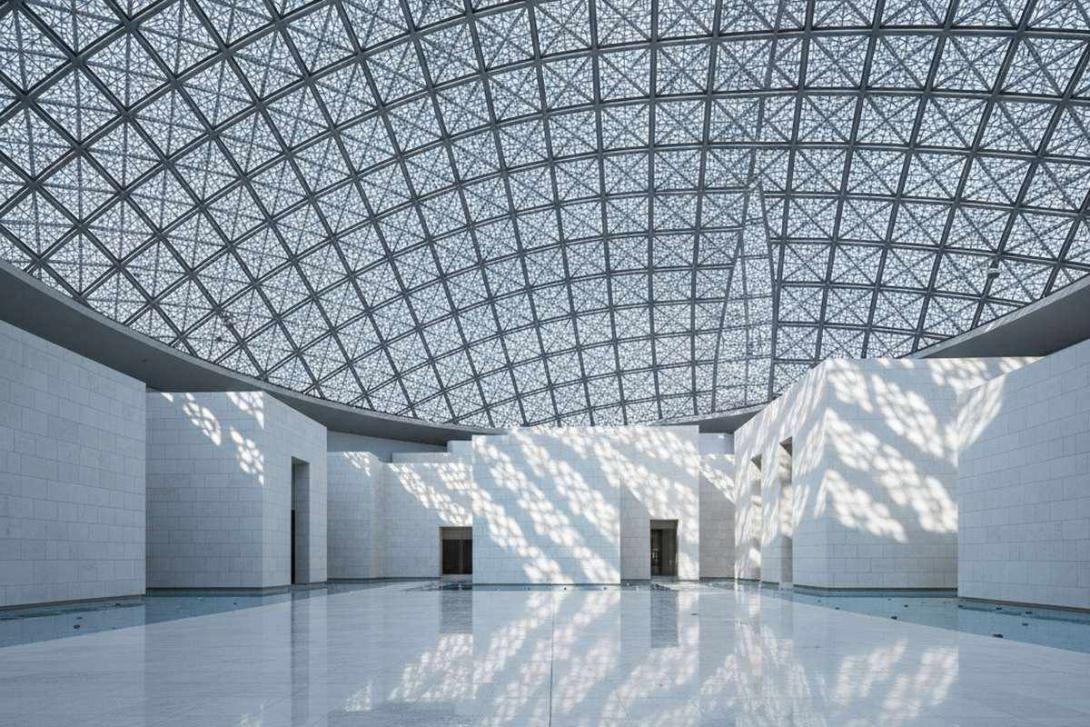
Louvre Abu Dhabi is the first universal museum in the Arab world and the only Louvre branch outside Paris, sitting on the water in Saadiyat Island's Cultural District. Designed by Pritzker Prize-winning French architect Jean Nouvel and opened in November 2017, it pairs a 180-metre silver dome with a cluster of low-rise white pavilions arranged like an Arab medina. The signature "rain of light" effect — sunlight filtering through 7,850 star elements layered across the dome — is reason enough to visit, but the cross-cultural collection makes it one of the UAE's most rewarding indoor days. This guide covers the architecture, the collection, ticketing, the visitor experience and how to combine the museum with the rest of Saadiyat Island.
At a Glance
| Field | Value |
|---|---|
| Location | Cultural District, Saadiyat Island, Abu Dhabi |
| Architect | Jean Nouvel (Pritzker Prize, France) |
| Opened | November 2017 |
| Permanent galleries | ~23 across 12 chapters of human history |
| Total museum area | ~24,000 m² of gallery and exhibition space |
| Famous feature | 180 m silver dome — 7,850 star elements in 8 layers, "rain of light" effect |
| Opening hours | Approx. 10:00–18:30 Tue–Sun; Thu & Sat to ~20:30 |
| Closed | Mondays (and varied Ramadan hours) |
| Admission | ~AED 60–65 adult; under-18s free; resident discounts |
| Distance from central Abu Dhabi (Corniche) | ~15 km / 15–20 min by car |
| Distance from Dubai | ~135 km / ~90 min via Sheikh Zayed Road (E11) |
Architecture
Jean Nouvel's brief was to design a building that felt at home on the Gulf coast while reading as a public square. The result is a museum-city: 55 separate white volumes — including 23 galleries — arranged on a flooded plaza and capped by a single floating dome. The architecture is inseparable from the visit; most people remember the dome before they remember any single artwork.
The Dome
The dome measures 180 metres across and weighs roughly 7,500 tonnes, close to the Eiffel Tower. It is a double-layer geodesic structure — four outer steel layers and four inner aluminium layers — holding 7,850 unique star-shaped perforations. As the sun tracks across the sky the perforations cast a constantly shifting filigree of light beams across the white walls, the basalt floor and the sea below. Nouvel calls it "rain of light"; visitors usually just stop talking when they walk under it. Mid-morning and the last hour before sunset are the sharpest viewing windows.
Materials and the Setting
Inside, the pavilions are clad in pale white plaster and concrete; outside, they sit directly on a tidal plaza so the Gulf laps the lower walls. Walking between galleries you cross open-air alleys where the dome filters daylight overhead and the sea reflects it back from below. The public plaza, café terrace and outdoor sculptures are worth a slow loop — and they are free to walk through.
The Collection
Louvre Abu Dhabi is a universal museum. Where most institutions group works by region or period, the curation here juxtaposes objects across cultures within a single gallery — a Buddhist sculpture beside an early Christian icon beside an illuminated Quran — to show how civilisations answered the same human questions in parallel.
Permanent Galleries
There are around 23 permanent galleries organised into 12 chapters that span prehistory to the present. Highlights include early monumental art, the great empires, sacred texts, world trade routes and a strong contemporary wing. The flow is chronological, but each room cross-cuts: medieval Europe sits next to the Islamic Golden Age; Asian and African material is given the same weight as the Mediterranean. A slow walk takes about two hours; a fast pass can be done in 60 minutes.
Notable Works and Long-Term Loans
A core feature of the 30-year agreement with France is a rotating programme of long-term loans from 13 French museums, including the Louvre, Musée d'Orsay, Centre Pompidou and Musée du quai Branly. Past and current loans have included works by Leonardo da Vinci, Vermeer, Manet, Gauguin, Van Gogh, Cy Twombly and Picasso. Specific items rotate, so check the museum's site close to your visit rather than assuming any single masterpiece will be hanging on the day.
Rotating Exhibitions
Louvre Abu Dhabi runs two to three major temporary exhibitions a year — usually themed around a civilisation, a French collection or a contemporary commission — alongside smaller focused displays. These sit in dedicated exhibition halls and usually carry a separate or upgraded ticket.
The Visitor Experience
Tickets
General admission is around AED 60–65 for adults. Under-18s enter free, and there are discounts for students, teachers, people of determination and Emirati residents. Special exhibitions, premium guided tours and family workshops are ticketed separately. Tickets are sold online on the museum's site and at the door; online is faster on weekends.
Audio Guides and the App
Audio guides are available in multiple languages, and the free Louvre Abu Dhabi app includes the same audio along with a self-guided map — bring headphones if you'd rather use your phone than rent a handset. A 60–90 minute "highlights" route is the best starting point for a first visit; the app also offers themed tours (architecture, sacred art, modern works).
The Children's Museum
A dedicated Children's Museum within the building runs interactive exhibitions designed for ages 4–10, with rotating themes (recent shows have explored animals in art and travel). Entry is included with general admission for children. The main galleries are also genuinely child-friendly — short routes, low-glare lighting, and plenty of bench seating.
Photography, Food and Accessibility
Photography is allowed in most galleries without flash; tripods, selfie sticks and drones are not. The on-site café offers light meals on a terrace overlooking the sea, and Fouquet's, a more formal French restaurant, sits on the plaza. The whole museum is step-free and wheelchair-accessible, with chairs available to borrow at the entrance.
Getting There
By Car
Most visitors drive. From central Abu Dhabi (the Corniche), follow signs for Saadiyat Island and the Sheikh Khalifa Bridge — the museum is roughly 15 km and 15–20 minutes outside rush hour. Free covered parking sits directly under and beside the building. From Dubai, take Sheikh Zayed Road (E11) south, then E10/E12 to Saadiyat; the drive is about 135 km and 90 minutes outside rush hour, longer on Friday and Saturday afternoons.
By Taxi or Ride-Hailing
Abu Dhabi taxis, Careem and Uber all serve the museum. From central Abu Dhabi expect roughly AED 35–55 one way; from Dubai Marina, AED 250–350.
By Bus
Abu Dhabi's public bus 94 connects central Abu Dhabi to Saadiyat Island and stops within walking distance of the museum. Inter-emirate coaches between Dubai and Abu Dhabi do not stop at Saadiyat directly — change to a local bus or taxi at Abu Dhabi bus station.
Best Time to Visit
- November to March is the best window: outdoor temperatures of 18–28 °C make the open-air plaza and dome walk genuinely pleasant. Pair the visit with a stroll on Mamsha Al Saadiyat or the Saadiyat Beach running track.
- April and October are still comfortable for indoor visits; save outdoor photography of the dome for late afternoon.
- May to September the museum is one of the best indoor escapes in the country — fully air-conditioned and uncrowded on weekdays, even at midday.
For lighting, the "rain of light" is at its most photogenic in the two hours after opening and the final hour before close. Thursdays and Saturdays, when the museum stays open until around 20:30, give you a chance to see the dome lit up after dark.
Practical Notes
- Closed Mondays — plan around it
- Hours and ticket prices shift during Ramadan; check the official site close to your visit
- Bag-size limits apply at the entrance; large backpacks go to the cloakroom (free)
- Photography is fine without flash; no drones, tripods or selfie sticks
- The site is alcohol-free except in licensed restaurants; smoking is not permitted
- Allow at least 2 hours for a first visit; 3–4 hours if you want temporary exhibitions and a meal
- The plaza and exterior are dramatic after sunset and worth a quick loop on the way out
Nearby
Louvre Abu Dhabi anchors the Cultural District and the area rewards a longer day. Manarat Al Saadiyat — a free contemporary art space — is a 5-minute walk and a good warm-up. Mamsha Al Saadiyat, the beachfront promenade with cafés and restaurants, connects to the public stretch of Saadiyat Beach. The future Guggenheim Abu Dhabi is under construction next door and will eventually form a three-museum cluster with Louvre and the planned Zayed National Museum.
For a half-day across central Abu Dhabi, the Sheikh Zayed Grand Mosque is a 20-minute drive south and pairs well as a late-afternoon stop, while Qasr Al Watan and the Corniche promenade sit roughly 15–20 minutes west.
Frequently Asked Questions
What is Louvre Abu Dhabi?
Louvre Abu Dhabi is a universal museum on Saadiyat Island, opened in November 2017 as the first branch of the Louvre outside Paris. Designed by Jean Nouvel, it houses around 23 permanent galleries under a 180-metre silver dome and rotates long-term loans from 13 French museums.
How much is a Louvre Abu Dhabi ticket?
General admission is approximately AED 60–65 for adults. Visitors under 18 enter free, and there are discounts for students, teachers, people of determination and Emirati residents. Major temporary exhibitions and premium tours are ticketed separately.
What time does Louvre Abu Dhabi open?
The museum opens at around 10:00 from Tuesday to Sunday and closes about 18:30 on most days, with later closing of around 20:30 on Thursday and Saturday. Hours shift slightly during Ramadan, so confirm on the official site before visiting.
Is Louvre Abu Dhabi closed on Mondays?
Yes. Louvre Abu Dhabi is closed every Monday for maintenance and gallery turnover. Plan your visit for any other day of the week.
Where is Louvre Abu Dhabi?
The museum sits in the Saadiyat Cultural District on Saadiyat Island, connected to mainland Abu Dhabi by the Sheikh Khalifa Bridge. It is roughly 15 km and 15–20 minutes from the Corniche by car.
How do I get to Louvre Abu Dhabi from Dubai?
The drive is about 135 km and around 90 minutes outside rush hour. Take Sheikh Zayed Road (E11) south, then follow signs for Saadiyat Island via E10/E12. Ride-hailing from Dubai Marina costs roughly AED 250–350 one way; there is no direct inter-emirate bus to Saadiyat, so transfer at Abu Dhabi bus station if travelling by public transport.
Is Louvre Abu Dhabi the same as the Paris Louvre?
No. It is a separate museum operating under a 30-year agreement between France and the UAE that allows it to use the Louvre name and to receive long-term loans from 13 French institutions, including the Paris Louvre. The collection, building and curation are distinct from the Paris museum.
What is the "rain of light" at Louvre Abu Dhabi?
It is the lighting effect created by sunlight filtering through 7,850 star-shaped perforations across the eight layers of the museum's silver dome. As the sun moves, the overlapping perforations cast a constantly shifting filigree of light beams onto the walls, floor and sea below. It is the museum's signature visual.
Is photography allowed inside Louvre Abu Dhabi?
Yes, in most galleries and without flash. Tripods, selfie sticks and drones are not permitted. Some temporary exhibitions restrict photography of specific loaned works — signage at the gallery entrance will indicate.
How much time should I budget for the visit?
Allow at least 2 hours for the permanent galleries and the dome plaza. Budget 3–4 hours if you plan to see a temporary exhibition or have a meal on the terrace.