الإمارات العربية المتحدة
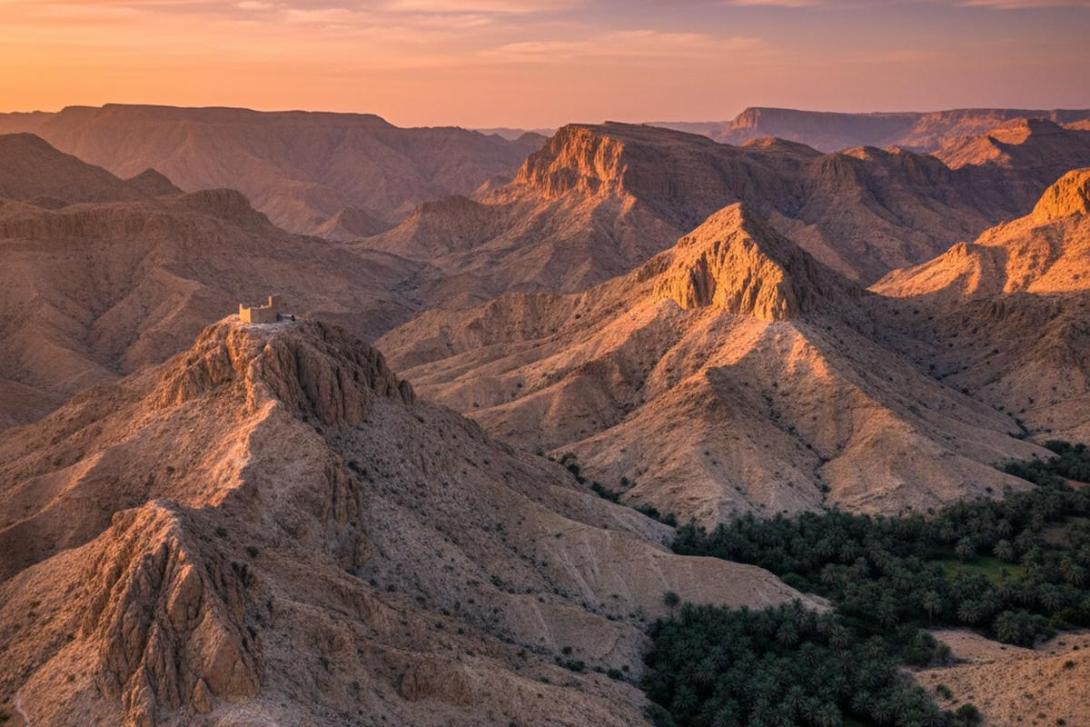
Masfout is a small mountain village deep in the Hajar range that, oddly, belongs to the emirate of Ajman — separated from coastal Ajman by roughly 110 km of Sharjah and Ras Al Khaimah territory. It sits at 700 to 1,000 metres elevation in the south-eastern UAE, close to the Oman border and a short drive from Dubai's own mountain enclave at Hatta. The draws are a restored stone fort, a winding network of paved mountain roads through limestone valleys, and air temperatures consistently 8 to 12 °C cooler than the coast.
At a Glance
| Field | Value |
|---|---|
| Location | Hajar Mountains, south-eastern UAE near the Oman border |
| Status / nature | Mountain exclave of Ajman emirate, separated from coastal Ajman by ~110 km |
| Elevation | ~700–1,000 m at village core; surrounding ridges to ~1,300–1,600 m |
| What's there | Masfout Castle, mountain drives, hiking, traditional date-palm farms |
| Climate vs coast | Typically 8–12 °C cooler than coastal Ajman |
| Hours | Village and roads 24/7; Masfout Castle approximately 9 a.m. – 5 p.m., Sat–Thu |
| Admission | Free |
| Distance from Ajman city | ~110–130 km / 90–100 minutes by car |
| Distance from Dubai | ~110 km / ~90 minutes via E66 (Dubai-Hatta Road) |
| Best for | Road-trippers, summer escape from coastal heat, photographers, geography enthusiasts |
The Setting
An Ajman Exclave
Masfout is one of the UAE's quirkier geographical curiosities. It belongs to Ajman emirate, but coastal Ajman is roughly 110 km away on the Gulf, separated from Masfout by Sharjah's interior and the southern fringes of Ras Al Khaimah. It is one of three notable exclaves in this corner of the country: Madha is an Omani exclave inside the UAE, Nahwa is a UAE enclave inside Madha, and Masfout is Ajman's own mountain outpost. The administrative arrangement dates to British-era boundary settlements and the historic tribal landholdings of the Al Nuaimi family, the same ruling family as coastal Ajman.
Geography
The village core sits in a basin at approximately 700 to 1,000 metres elevation, ringed by limestone peaks rising to 1,300 to 1,600 metres on the surrounding ridges. The terrain is classic Hajar — bare grey rock, sharp wadis, and the occasional ribbon of green where falaj irrigation channels feed terraced date palms. The population is small, a few thousand residents across the main village and outlying hamlets. The mountain road network is fully paved and unusually well-maintained for a settlement of this size, with secondary roads climbing further into the ridges and descending into smaller valleys on engineered switchbacks. The nearest larger mountain destination is Hatta, only 10 to 15 minutes' drive away.
Climate
Climate is the practical reason most people drive up. Elevation and inland position keep daytime temperatures 8 to 12 °C below the coast for most of the year, with much lower humidity. When coastal Ajman pushes 45 °C in high summer, Masfout sits in the mid-30s with dry, breathable air. Winter nights drop close to freezing on the higher ridges, and morning mist in the wadis is a recurring sight from late November through February. Rainfall is more frequent than on the coast — still modest, but enough to sustain the date-palm farming that defines the local landscape.
What to Do
Masfout Castle
Masfout Castle — also called Al Hajar Castle or Masfout Fort — is the village's headline heritage site. It is a compact stone fort on a rocky outcrop above the village, originally built in the early 20th century and historically used by the ruling Al Nuaimi family as a mountain seat. The building has been restored in recent years and is now open to visitors as a heritage attraction. Entry is free.
The fort is small — a single-tower structure with a walled courtyard, an internal staircase, and a flat roof with a near-360-degree view across the basin. Allow 30 to 45 minutes for a casual visit, longer at golden hour for photography. There is no formal ticketing or guided tour; signage is limited and an English-speaking guide is not always on site. Modest dress is expected — the fort is a living heritage site rather than a museum.
Mountain Drives
The mountain road network is the second reason most visitors come. From the village, paved roads climb through limestone valleys, swing across ridges with views south towards Oman, and drop into smaller wadis on tight switchbacks. None of the roads require a 4x4, but the gradients are real and brakes get a workout on the descents. Allow two to three hours for a relaxed loop with stops, longer at sunset when the limestone goes pink and gold. The roads are a quiet magnet for weekend motorcyclists from Dubai and Sharjah; you will rarely see other tourists.
Hiking
There is no formal paid hiking infrastructure at Masfout — no ticketed trails, no marked routes, no visitor centre. Instead, a quiet network of informal paths runs through wadis and along ridge lines, mapped over time by hikers on Wikiloc and AllTrails. Routes range from gentle hour-long wadi strolls to half-day ridge climbs gaining several hundred metres. Conditions are unforgiving — bare rock, scree, very little shade — and the ridges should not be attempted in summer daytime heat. For a graded, marked alternative with visitor infrastructure, Jebel Jais in Ras Al Khaimah has signposted trails.
Local Villages and Farms
The smaller hamlets around Masfout are working agricultural settlements rather than tourist sites, but rewarding to drive through at low speed. Date-palm groves are still cultivated using falaj — the centuries-old gravity-fed irrigation channels that thread through the rock — and terraced plots produce vegetables, lemons, and feed for goats. The cultural character is mountain-Bedouin, distinct from coastal Ajman, and most residents are from the same Al Nuaimi tribe as the ruling family. Photography of people, livestock, and homes should be done with permission.
Getting There
From Dubai
The fastest route from central Dubai is the Dubai-Hatta Road (E66) east through the desert and into the mountains, reaching Hatta in about 75 minutes. From Hatta, signage onwards to Masfout takes you up over a short pass — another 10 to 15 minutes. Total travel time from central Dubai is roughly 90 minutes, distance around 110 km. The road is fully paved and a 4x4 is not required.
From Coastal Ajman or Sharjah
The journey from coastal Ajman is longer than first-time visitors expect — the route runs south-east across Sharjah's interior on E55 and onward roads, joining the Dubai-Hatta corridor before climbing into the mountains. Allow 90 to 100 minutes and roughly 110 to 130 km. There is no direct route that avoids crossing at least one other emirate.
From Hatta
From Hatta, Masfout is 10 to 15 minutes' drive over the connecting pass. Many visitors base themselves in Hatta and use Masfout as a half-day side-trip.
By Public Transport
There is no practical public transport to Masfout. RTA bus services from Dubai run as far as Hatta on the E16 route, but onward connection into the Masfout valley is by private car or taxi only. A self-drive day trip is the standard approach.
Best Time to Visit
- November to March — peak season. Daytime air temperatures sit in the high teens to high twenties; nights are cold on the ridges. Mornings can bring mist in the wadis. Ideal for hiking and long mountain drives.
- April and October — shoulder season. Pleasant in the morning and late afternoon; midday is warmer but still well below coastal levels.
- May to September — high summer. Coastal Ajman is brutal; Masfout, sitting 8 to 12 °C cooler with much lower humidity, becomes a popular weekend escape for residents who can drive up. Avoid midday hiking. Early-morning and late-afternoon visits are still rewarding.
For sunset photography, time the drive so that you reach an upper viewpoint or the fort's roof terrace 45 to 60 minutes before sundown.
Practical Notes
- Petrol stations are sparse — fill up in Hatta, central Dubai, or Sharjah's interior before heading up
- Mobile coverage is variable; reception drops in the deeper wadis
- Bring water, snacks, and a hat — there are very few cafés outside the main village
- The fort is open during approximate daylight hours (~9 a.m. – 5 p.m. Saturday to Thursday); the village and roads are 24/7
- Modest dress is expected — Masfout is a working village, not a tourist resort
- A 4x4 is not required, but tyres should be in good condition for the gradients
- Cash is sometimes the only option in smaller shops
- The area is dry — no alcohol service; licensed venues are in Hatta or Dubai
- Photograph locals, livestock, and homes only with permission
Nearby
Masfout pairs most naturally with Hatta, Dubai's mountain enclave 10 to 15 minutes away, which has the Hatta Dam, kayak rentals, a heritage village, and several hotels. A common one-day itinerary leaves Dubai at sunrise, spends the morning at Hatta Dam, drives across to Masfout for the fort, and returns in the late afternoon. For a longer mountain trip, Jebel Jais in northern Ras Al Khaimah sits roughly 110 to 130 km away and offers the country's most-developed adventure infrastructure — though a fundamentally different experience from Masfout's quiet character. Returning to Ajman city, Ajman Corniche is the natural place to catch dinner on the coast.
Frequently Asked Questions
What is Masfout?
Masfout is a small mountain village in the Hajar range that belongs to Ajman emirate, despite sitting roughly 110 km from coastal Ajman. It is at around 700 to 1,000 metres elevation in the south-eastern UAE near the Oman border, known for a restored stone fort, scenic mountain drives, and cooler air than the coast.
Why is Masfout part of Ajman if it's so far away?
Masfout is an exclave of Ajman dating to British-era boundary settlements and the historic tribal landholdings of the Al Nuaimi family. Several emirates in the Northern UAE have non-contiguous territory of this kind.
How high is Masfout?
The village core sits at roughly 700 to 1,000 metres elevation, with surrounding ridges rising to around 1,300 to 1,600 metres.
How do I get to Masfout from Dubai?
Take the Dubai-Hatta Road (E66) east to Hatta, then signposted roads up the connecting pass to Masfout — around 110 km and 90 minutes total. Fully paved; no 4x4 required.
Is Masfout Castle worth visiting?
Yes. The restored fort is free to enter, takes 30 to 45 minutes to explore, and offers a wide view across the basin from the roof — particularly worthwhile at golden hour.
What is there to do in Masfout?
The main draws are Masfout Castle, paved mountain drives through limestone valleys, informal hiking through wadis and ridges, and traditional date-palm villages. There is no formal adventure infrastructure — Masfout is a quieter, more rural mountain experience than Hatta or Jebel Jais.
Is Masfout cooler than coastal Ajman?
Yes. Elevation and inland position keep Masfout typically 8 to 12 °C cooler than coastal Ajman, with much lower humidity. This is the main reason residents visit in summer.
Can you combine Masfout with Hatta?
Yes — and most visitors do. Hatta is only 10 to 15 minutes' drive away, making the two enclaves a natural single-day itinerary.
Do I need a 4x4 to visit Masfout?
No. The roads in and around Masfout, including the connecting pass from Hatta, are fully paved. A 4x4 is only relevant if you want to drive off-road into the wadis.
When is the best time to visit Masfout?
November to March for peak conditions. April and October are pleasant shoulder months. Summer is viable thanks to the elevation, but stick to early-morning and late-afternoon outings.