الإمارات العربية المتحدة
Qasr Al Hosn — Al Hosn Fort — is the oldest standing building in Abu Dhabi city and the original nucleus around which the modern capital grew. The structure began life around 1761 as a single coral-stone watchtower built to protect the freshwater well that had drawn the first settlers onto the island. Over the next two centuries it was expanded into the principal residence of the ruling Al Nahyan family and the seat of government from which Sheikh Zayed launched the modernisation that produced the present-day UAE. After an 11-year restoration, the fort reopened in 2018 as a museum and cultural quarter. This guide covers what to see and how the visit differs from the modern Presidential Palace at Qasr Al Watan.
At a Glance
| Field | Value |
|---|---|
| Location | Al Hosn district, central Abu Dhabi island |
| Original watchtower built | ~1761, to protect the island's freshwater well |
| Inner fort built | ~1793, after the Al Nahyan family relocated from Liwa |
| Outer palace built | 1939–1945, under Sheikh Shakhbut bin Sultan |
| Reopened as museum | December 2018, after an 11-year restoration |
| Hours | Approximately 9 a.m. – 7 p.m. Tue–Sun; closed Mondays |
| Admission | Approximately AED 30 adult, AED 15 child; under-4s free |
| Distance from Corniche | ~5 minutes by car |
| Distance from Louvre Abu Dhabi | ~15 minutes via Sheikh Khalifa Bridge |
| Distance from Dubai | ~135 km / 80–90 minutes via E11 |
| Best for | History-curious visitors, families, anyone wanting to understand Abu Dhabi beyond the modern Yas/Saadiyat narrative |
History: 250 Years on a Single Site
Qasr Al Hosn is unusual among UAE forts: the building you see today is a continuous structure, not a reconstruction — the same walls layered up across more than two centuries.
The Watchtower (~1761)
The first structure was a single watchtower built in stone and coral around 1761 to guard the freshwater well discovered on what was otherwise a dry coastal island. The well turned a seasonal Bani Yas fishing camp into a permanent settlement. That original tower is still standing today, embedded in the inner fort — you can walk to its base and look up at the original masonry.
The Inner Fort (~1793)
In 1793, the Al Nahyan branch of the Bani Yas — the present-day ruling family — relocated their seat from Liwa to the island, and the watchtower was expanded into a small fort. Curtain walls extended outward, corner towers were added, and an internal courtyard with residential rooms and a majlis appeared. Construction is traditional Gulf coral-stone and gypsum. The inner fort served as residence and seat of government across the 19th and early 20th centuries.
The Outer Palace (1939–1945)
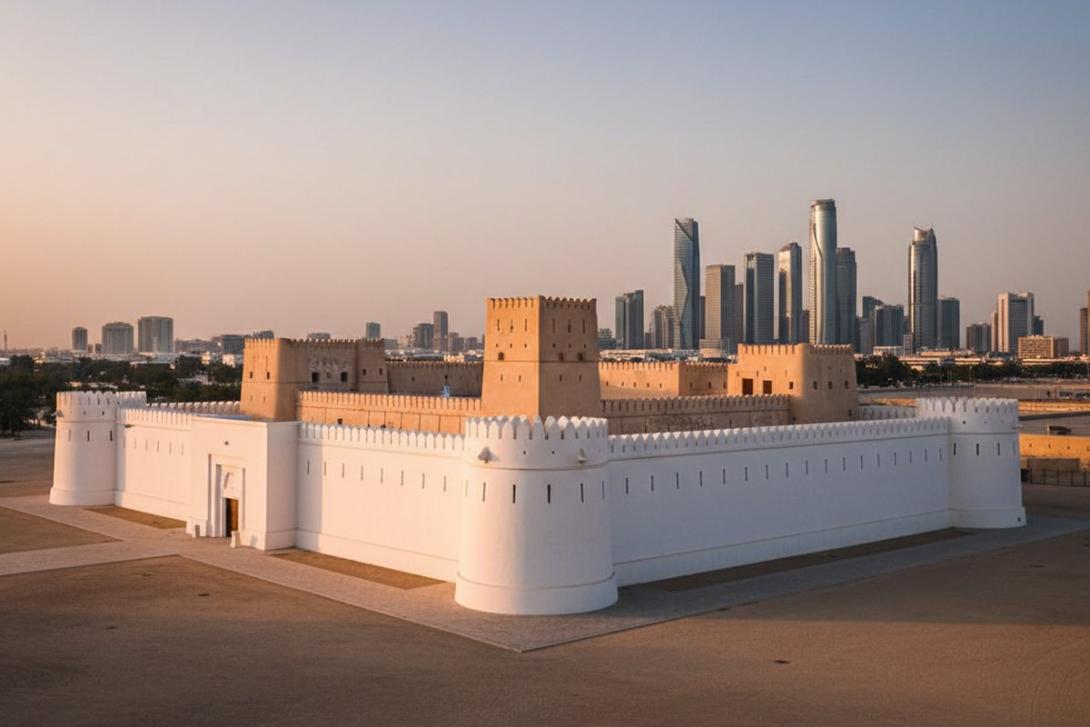
Between 1939 and 1945, under Sheikh Shakhbut bin Sultan Al Nahyan, the fort was wrapped in a much larger outer building — the white-painted modern wing visible from the street today, with larger reception halls and a more elaborate facade. This is the white building most people picture when they hear "Qasr Al Hosn"; the older inner fort is concealed inside it. Sheikh Zayed bin Sultan Al Nahyan succeeded his brother in 1966 and used Qasr Al Hosn as his residence and government seat through the early years of his rule, including the period leading up to the formation of the UAE on 2 December 1971.
The 2018 Restoration
By the 1980s the ruling family had moved out, and the fort fell into a slow decline. In 2007 it was closed for what became an eleven-year restoration — one of the longest single-building conservation projects in the country. The work exposed the original coral-stone fabric, stabilised the towers, and replaced damaged timber. The complex reopened in December 2018 at a reported cost above AED 130 million. Unusually for a UAE heritage project, the restoration is conservative rather than reconstructive — the inner fort is presented close to its 18th-century state.
The Museum Today
The visit covers four buildings on a single walled site. Plan on two to three hours.
The Inner Fort Galleries
The inner fort is the historic core: the original 1761 watchtower, 1793 curtain walls, and the well. Exhibits are deliberately restrained — short bilingual panels, a few archaeological finds, and reconstructions of pearl-era furniture. The point is to walk the building, look up at the palm-trunk beams, and stand in the courtyard the founding rulers stood in.
The Outer Palace Exhibition
The outer palace houses the main exhibition, covering Abu Dhabi from the 18th century to the present: the pearl economy and its 1930s collapse, the discovery of oil, federation in 1971, and the urban transformation that followed. Highlights include the Al Nahyan family lineage on a wall-sized chart, archive photographs of the city when the fort was still surrounded by sand, and royal artefacts — robes, ceremonial swords, and personal effects of the ruling family. This is the section that makes the strongest case for visiting: a fishing settlement of a few thousand became an oil capital in a single human lifetime.
The Cultural Foundation
The Cultural Foundation, adjacent inside the same compound, was Abu Dhabi's first dedicated arts and cultural centre when it opened in 1981. After its own restoration it now hosts temporary exhibitions, a public library, a children's art space, and a small performance venue.
The House of Artisans (Bait Al Hirfa)
The House of Artisans is, for many visitors, the most engaging building. It is a working artisan centre, free to enter, with live demonstrations of traditional Emirati crafts: sadu and talli weaving, palm-frond basketry (khoos), silver jewellery work, and Arabic calligraphy. Most demonstrators speak Arabic and English. Short paid workshops are offered most days. A fourth structure on site is the original National Consultative Council building, the small room where the body preceding the Federal National Council met.
Distinguishing from Qasr Al Watan
Qasr Al Hosn and Qasr Al Watan are easy to confuse — both palatial, both state-related — but they tell opposite halves of the city's story. Qasr Al Hosn is the historic origin: the oldest building in the city, a coral-stone watchtower expanded into a fort, the seat from which the founding rulers governed before federation. The architecture is 18th- and early-20th-century Gulf vernacular — thick walls, palm-frond beams, modest scale. Qasr Al Watan is the modern Presidential Palace: a working state building opened to visitors in 2019, all polished marble, gold-leaf domes, and contemporary Arab-Islamic monumentality. Visit both for the bookends of Abu Dhabi's story — the fort in the morning, the palace in the late afternoon for the "Palace in Motion" show.
Getting There
By Car
Qasr Al Hosn sits in central Abu Dhabi, between the Corniche and the central business district. From the Corniche it is roughly 5 minutes; from Yas Island, around 25 minutes; from Sheikh Zayed Grand Mosque, 15–20 minutes; from Louvre Abu Dhabi, 15 minutes via the Sheikh Khalifa Bridge. From Dubai, around 135 km / 80–90 minutes via the E11. Free visitor parking is at the entrance, with paid public parking on surrounding streets.
By Taxi or Ride-Hailing
Careem and Uber operate across Abu Dhabi. From the Corniche a one-way ride is roughly AED 15–25; from Yas Island, AED 60–90; from Dubai Marina, AED 230–320.
By Bus
Several Abu Dhabi city bus routes run within walking distance, including services along Hamdan Street and Khalifa Street. From Dubai there is no direct inter-emirate bus to Al Hosn; the practical route is the E100 / E101 coach to Abu Dhabi terminal followed by a short taxi.
Best Time to Visit
- November to March — peak season, comfortable air temperatures of 18–28 °C. Mornings are quietest.
- April and October — workable, but aim for early entry or after 4 p.m.
- May to September — interiors are heavily air-conditioned, but courtyards become uncomfortable from late morning. Visit at opening or in the last two hours before close.
Closed Mondays. Ramadan hours are shortened. The annual Qasr Al Hosn Festival, when it runs, turns the compound into an outdoor heritage venue with food stalls, performances, and craft workshops in the cooler months.
Practical Notes
- Allow two to three hours for a full visit covering all four buildings
- Photography allowed throughout; no flash near artefacts, no tripods, no drones
- The House of Artisans is free without a museum ticket
- Confirm ticket prices on the official site; bundle tickets are sometimes available
- Modest dress appreciated — covered shoulders and knees
- Largely step-free at ground level; upper-tower viewing points require stairs
- A small café operates on site; Hamdan Street has wider food choice within a 5-minute drive
- Interpretation is in Arabic and English; captions are concise
- Cash and card both accepted
Nearby
The Corniche running track is a 5-minute drive north for a sunset walk along the Gulf. World Trade Center Mall and the old souq district are within walking distance. Louvre Abu Dhabi on Saadiyat Island is 15 minutes by car via the Sheikh Khalifa Bridge — the most natural cultural pairing for a full day. Sheikh Zayed Grand Mosque is 15–20 minutes south for an early-morning visit before an afternoon at Al Hosn. Across town to the west, Qasr Al Watan closes the historical loop with the modern presidential palace.
Frequently Asked Questions
What is Qasr Al Hosn?
Qasr Al Hosn — Al Hosn Fort — is the oldest standing building in Abu Dhabi city. It began as a watchtower around 1761, was expanded into a fort and ruling-family residence, and reopened in December 2018 as a museum after an 11-year restoration.
How old is Qasr Al Hosn?
The original watchtower at the centre of the inner fort dates to about 1761, making it more than 260 years old. The inner fort walls were added around 1793, and the white outer palace was built between 1939 and 1945.
Is Qasr Al Hosn the same as Qasr Al Watan?
No. Qasr Al Hosn is the historic 18th-century fort in central Abu Dhabi — the oldest building in the city. Qasr Al Watan is the working modern Presidential Palace at Ras Al Akhdar, opened in 2019. Different buildings, different parts of the city, different parts of the story.
How much is admission?
Adult tickets are approximately AED 30, with reduced rates of around AED 15 for children. Under-4s are normally free. Bundle tickets with other Abu Dhabi cultural sites are sometimes available. Confirm pricing on the official site, as fees are revised periodically.
What are the opening hours?
Approximately 9 a.m. to 7 p.m. Tuesday through Sunday. Closed Mondays. Ramadan hours are shortened.
Where is Qasr Al Hosn located?
In the Al Hosn district of central Abu Dhabi, between the Corniche and the central business district. Around 5 minutes by car from the Corniche, 15 minutes from Louvre Abu Dhabi, and 135 km / 80–90 minutes from Dubai via the E11.
What can I see inside?
Four buildings within a single walled compound: the inner fort (the 1761 watchtower and 1793 walls), the outer palace (main exhibition on Abu Dhabi's history), the Cultural Foundation (temporary exhibitions and a library), and the House of Artisans (live craft demonstrations).
How long do I need?
Two to three hours for a thorough visit covering all four buildings. A focused visit of just the inner fort and outer-palace exhibition can be done in 90 minutes.
Is the House of Artisans free?
Yes. The House of Artisans (Bait Al Hirfa) is free to enter without a museum ticket. Short paid craft workshops are available.
Is photography allowed?
Yes, throughout the site. Flash is not permitted near artefacts, and tripods and drones are not allowed.