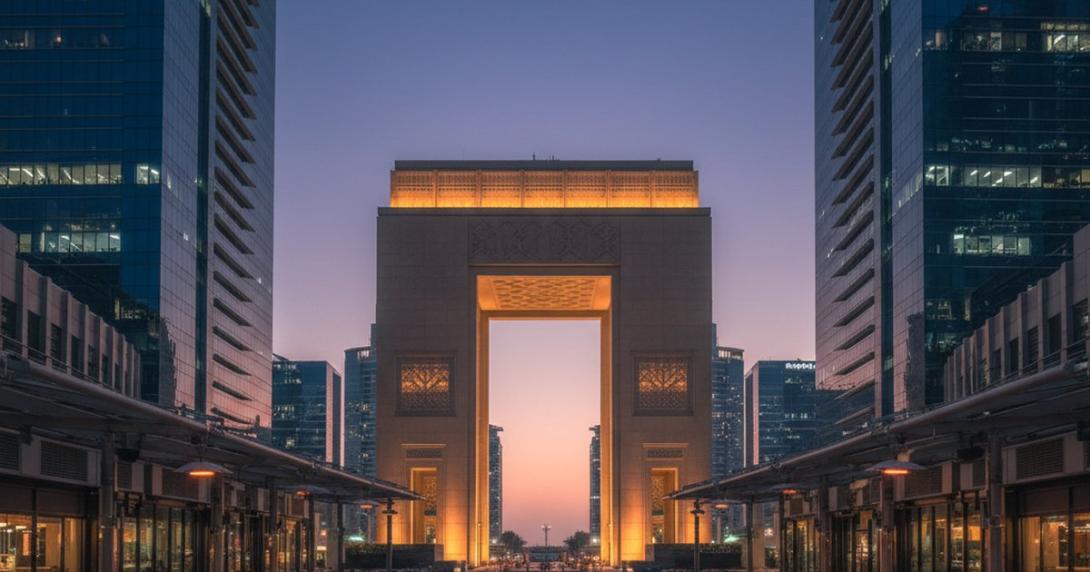
Ask any Gulf banker where the deals get done and the answer is the same: DIFC. Founded in 2004 on a 110-acre block off Sheikh Zayed Road, the Dubai International Financial Centre has become the dominant financial cluster between London and Singapore — over 5,500 active firms, roughly three-quarters of the world's top 50 banks, and around 40,000 working professionals. It runs on English common law, an independent regulator (the DFSA) modelled on the UK's FCA, and its own courts. This article steps past the licensing mechanics covered on the DIFC free-zone page and looks at the human side: who is based there, why they chose to be, and what the ecosystem feels like on the ground.
At a Glance
| Field | Value |
|---|---|
| Founded | 2004 |
| Location | Central Dubai, between Sheikh Zayed Road and Emirates Towers |
| Companies | 5,500+ active firms |
| Headcount | ~40,000 professionals on site |
| Top sectors | Banking, asset management, insurance and reinsurance, family offices, fintech, professional services |
| Top tenants | HSBC, Standard Chartered, Citi, JPMorgan, Goldman Sachs, BlackRock, Lloyd's of London, KPMG, Clifford Chance |
| Distinctive feature | English common law, independent DFSA regulation, dedicated DIFC Courts |
| Why pick DIFC | Network effects with global finance, top-tier regulator, deep talent pool, ecosystem of supporting professional services |
Who's at DIFC
What makes DIFC unusual is not its tax regime — most UAE free zones offer similar incentives — but the density of who is on the tenant list. A short walk between the Gate Building and Index Tower covers more global finance brand names than anywhere east of the City of London.
Banks
Banking is the foundation tenant base. Roughly 75% of the world's top 50 banks have a DIFC presence — sometimes a full booking centre, sometimes a regional HQ, sometimes a representative office. The roll-call includes HSBC, Standard Chartered, Citi, Goldman Sachs, JPMorgan, Bank of America, Credit Agricole, Deutsche Bank, BNP Paribas, Société Générale, UBS, Barclays, Mizuho, MUFG, and Nomura, alongside leading Gulf institutions such as Emirates NBD, Mashreq, First Abu Dhabi Bank, and the major Saudi banks. Corporate and investment banking, treasury, debt capital markets, and private-wealth desks for the wider region are typically here.
Asset managers
Asset management has been the fastest-growing cluster. DIFC-domiciled funds hold over USD 700 billion in AUM. BlackRock, Fidelity, JP Morgan Asset Management, Goldman Sachs Asset Management, Invesco, Franklin Templeton, and Schroders all operate from the centre. Sovereign wealth funds and their external managers cluster nearby — relationships with Mubadala, ADIA, PIF, and the major Kuwaiti and Qatari pools are mostly run out of DIFC desks. The full fund-domiciliation toolkit (Public Funds, Exempt Funds, Qualified Investor Funds) has pulled most regional private-equity GPs and Gulf VC firms into DIFC structures.
Insurance and reinsurance
DIFC is the regional reinsurance and specialty-insurance hub. Lloyd's of London runs its Middle East platform out of DIFC — the first time Lloyd's set up a regulated platform of this kind outside its London market. Swiss Re, Munich Re, Allianz, AIG, Zurich, Chubb, AXA XL, and Tokio Marine all maintain DIFC operations, alongside the major brokers (Marsh, Aon, WTW, Gallagher). Specialty lines dominate — energy, marine, aviation, political-risk, parametric.
Family offices
Gulf family wealth has matured fast, and DIFC has built deliberately for it. The centre has a dedicated family-arrangements regime — Prescribed Companies, Foundations, and a Single Family Office structure — that lets families consolidate holding entities, succession planning, and philanthropic vehicles under one common-law roof. Most major regional family offices have something here, and a growing number of European, Indian, and Asian family offices have followed clients into DIFC structures.
Fintech
The DIFC FinTech Hive launched in 2017 as the first fintech accelerator in MENA and seeded what is now a 750+ fintech firm community. Tabby (BNPL), Pyypl (digital payments), Sarwa (robo-advisory), and Baraka (commission-free trading) ran through Hive cohorts or are based on site. The Hive pairs with the Innovation Licence as a lower-cost entry route, with founders typically graduating to a full DFSA permission. Bank-fintech partnerships are routine — Emirates NBD, Mashreq, HSBC, and Standard Chartered all run cohort programmes from the same buildings.
Big 4 audit and law firms
Wherever finance concentrates, the supporting firms follow. All Big 4 — KPMG, PwC, Deloitte, EY — have major DIFC operations covering audit, tax, transactions, and financial-services advisory. The law-firm presence is similarly deep: Clifford Chance, Linklaters, Allen & Overy (now A&O Shearman), Latham & Watkins, Norton Rose Fulbright, Baker McKenzie, DLA Piper, White & Case, and Dentons all run their regional financial-services practices here. Add McKinsey, BCG, Bain, and Oliver Wyman, and the expertise within a five-minute walk is unusually concentrated.
The Setting and Lifestyle
DIFC does not feel like a generic office park. The Gate Building — the trapezoidal sandstone-clad arch at the centre — is the district's visual signature. Gate Avenue runs underneath and beyond it: a partly covered pedestrian street with cafés, galleries, and retail, designed to keep foot traffic flowing year-round despite Dubai's summer heat. Index Tower dominates the skyline at the eastern edge, mixing law firms, asset managers, and apartments. The adjacent Emirates Towers complex sits just outside the legal DIFC boundary but is functionally part of the same district.
The food and beverage scene is part of the financial workflow. Zuma in Gate Village remains the default venue for closing dinners and senior pitch meetings. Roberto's, La Petite Maison, Cipriani, Coya, and Gaia all sit within the cluster — many deals do get sketched out across those tables. Brew, Common Grounds, and Joe & The Juice keep the cafés busy from 7 am.
The Financial Centre Station on the Red Line of the Dubai Metro sits at the southern edge of the district, with lift access directly into the Emirates Towers complex. Most internal movement around DIFC happens on foot — it was master-planned around walkability in a way most of Dubai was not.
Why Pick DIFC for Your Business
The headline reasons are individually well-known. What makes DIFC hard to replicate is that they reinforce each other.
- English common law jurisdiction. Contracts use the legal vocabulary international finance already speaks — fiduciary duty, equitable remedies, common-law trusts, ISDA documentation. Disputes go to the DIFC Courts, with judges drawn from England, Singapore, Hong Kong, and Australia.
- Top-tier financial regulator. The DFSA is independent, modelled on the UK's FCA, and respected globally. A DFSA permission carries weight with international counterparties and correspondent banks in a way a standard UAE licence does not.
- Network effects with global banks. With 75% of the world's top 50 banks on site, opening a corporate bank account, finding a custodian, or syndicating a deal happens within walking distance.
- Talent pool. Senior finance professionals across banking, asset management, law, and consulting are concentrated here. Hires can move between firms without changing commute, making DIFC a gravitational point for talent flows from London, Singapore, and Mumbai.
- Ecosystem services. Big 4, magic-circle and white-shoe law firms, management consultancies, and specialist fund administrators are all on site. A DIFC-based fund can run audit, legal, fund administration, regulatory advisory, and tax within a five-minute radius.
DIFC fits alongside the UAE business guide, regulations overview, and startup ecosystem map — finance is one pillar among several, and it is the pillar that runs through DIFC.
DIFC vs ADGM
ADGM — the Abu Dhabi Global Market, established in 2015 — is DIFC's main UAE counterpart. Many groups end up with entities in both, but the choice between them is real.
| Dimension | DIFC | ADGM |
|---|---|---|
| Founded | 2004 | 2015 |
| City | Dubai | Abu Dhabi (Al Maryah Island) |
| Active firms | 5,500+ | ~3,000+ |
| Legal system | English common law via DIFC-specific statutes | English statute and case law applied directly |
| Regulator | DFSA | FSRA |
| Banking depth | Deepest regional book; ~75% of top 50 global banks | Strong but smaller |
| Asset management | USD 700B+ AUM in DIFC-domiciled funds | Growing, sovereign-aligned mandates |
| Crypto and virtual assets | Mature, but ADGM is regarded as stronger | Among the strongest globally |
| Fintech | FinTech Hive since 2017, 750+ fintech firms | Hub71 spillover, catching up |
| Best fit | Established banks, asset managers, insurers, family offices | Capital-markets firms, virtual assets, sovereign-aligned plays |
The short version: DIFC is the older, deeper, more banker-led centre; ADGM is the newer, more direct English-law jurisdiction with the strongest virtual-assets framework in the region. For most international banks and global asset managers, DIFC remains the default. For digital-asset platforms and certain capital-markets businesses, ADGM is increasingly the first choice.
Trade-offs
DIFC is not the right answer for every business, and the costs are real.
- Cost. DIFC office rents and licence fees sit at the top of the UAE range. Grade-A space in Index Tower, ICD Brookfield Place, or Central Park Towers commands premium rents, with DFSA application and supervision fees stacked on top. For an early-stage firm without a financial-services purpose, the maths rarely works.
- Heavy regulation. The DFSA process is deliberately thorough — regulatory business plans, fit-and-proper assessments, capital-adequacy, AML and risk frameworks. Full permissions take six to twelve months. The trade-off is credibility, but the runway needs to allow for it.
- Activity restriction. DIFC is finance-only by design. The DFSA does not licence general trading, manufacturing, e-commerce, or non-financial professional services the way DMCC or IFZA do. If your business is not financial in character, options are narrow.
DIFC is purpose-built for regulated finance and the ecosystem around it, and is unmatched at that one thing. Outside that scope, other free zones will be cheaper, faster, and more flexible.
Frequently Asked Questions
Is DIFC the same as Dubai's mainland?
No. DIFC is a financial free zone with its own legal system (English common law), its own courts (the DIFC Courts), and its own financial regulator (the DFSA). It sits inside Dubai geographically but is legally ring-fenced from UAE civil law and the Dubai mainland licensing regime.
Which banks are in DIFC?
Roughly 75% of the world's top 50 banks. The roll-call includes HSBC, Standard Chartered, Citi, JPMorgan, Goldman Sachs, Bank of America, Credit Agricole, Deutsche Bank, BNP Paribas, UBS, and Barclays, alongside leading Gulf banks such as Emirates NBD, Mashreq, and First Abu Dhabi Bank.
What law applies in DIFC?
English common law, applied through DIFC-specific statutes. Contracts inside DIFC, employment relationships, data protection, companies, and insolvency all run on a common-law framework rather than UAE civil law. Disputes are heard in the DIFC Courts, with judges drawn from common-law jurisdictions including England, Singapore, Hong Kong, and Australia.
Can a non-financial business be in DIFC?
In limited circumstances. Holding companies, family-arrangement vehicles, retail tenants in Gate Avenue, and certain professional-services firms (law, accounting, consulting) can operate inside DIFC. But DIFC is finance-only by design — for general trading, e-commerce, manufacturing, or broad professional services, DMCC, IFZA, or other broad-activity free zones are the right home.
What's the cost of setting up in DIFC?
A regulated financial firm typically spends from AED 50,000 upwards on the DIFC Authority commercial licence and office costs, with DFSA application and supervision fees on top — varying widely by activity category. The Innovation Licence for early-stage fintechs is a lower-cost entry route at roughly AED 5,000–10,000 with activity restrictions. Numbers depend heavily on category, headcount, and office footprint.
How does DIFC compare with ADGM?
Both are English-common-law financial free zones inside the UAE. DIFC (2004) is older, larger, and has the deeper banking and asset-management book. ADGM (2015) is in Abu Dhabi, applies English statute and case law more directly, and has a stronger virtual-assets framework. Many international groups maintain entities in both, choosing based on where the specific business line fits best.
What is the FinTech Hive at DIFC?
The FinTech Hive is the DIFC-run fintech accelerator launched in 2017 — the first of its kind in MENA. It runs cohorts across payments, lending, wealth-tech, regtech, insurtech, and Islamic fintech, with bank partners (Emirates NBD, Mashreq, HSBC) providing test environments. Graduates often progress to a DFSA Innovation Licence and then full authorisation. The wider DIFC fintech community now numbers 750+ firms.
Where can I find a DIFC restaurant for a business meeting?
Default options are Zuma, Roberto's, La Petite Maison, Cipriani, Coya, and Gaia — all walking distance from each other in Gate Village and Gate Avenue. Zuma is the regional finance lunch venue. For casual coffee meetings, Common Grounds, Brew, and Joe & The Juice along Gate Avenue work well.
Is DIFC near a Dubai Metro station?
Yes. Financial Centre Station on the Red Line sits at the southern edge of DIFC, with lift access directly into the Emirates Towers complex. From there, the Gate Building, Gate Avenue, and Index Tower are all a short walk. Most internal movement around DIFC happens on foot.