الإمارات العربية المتحدة
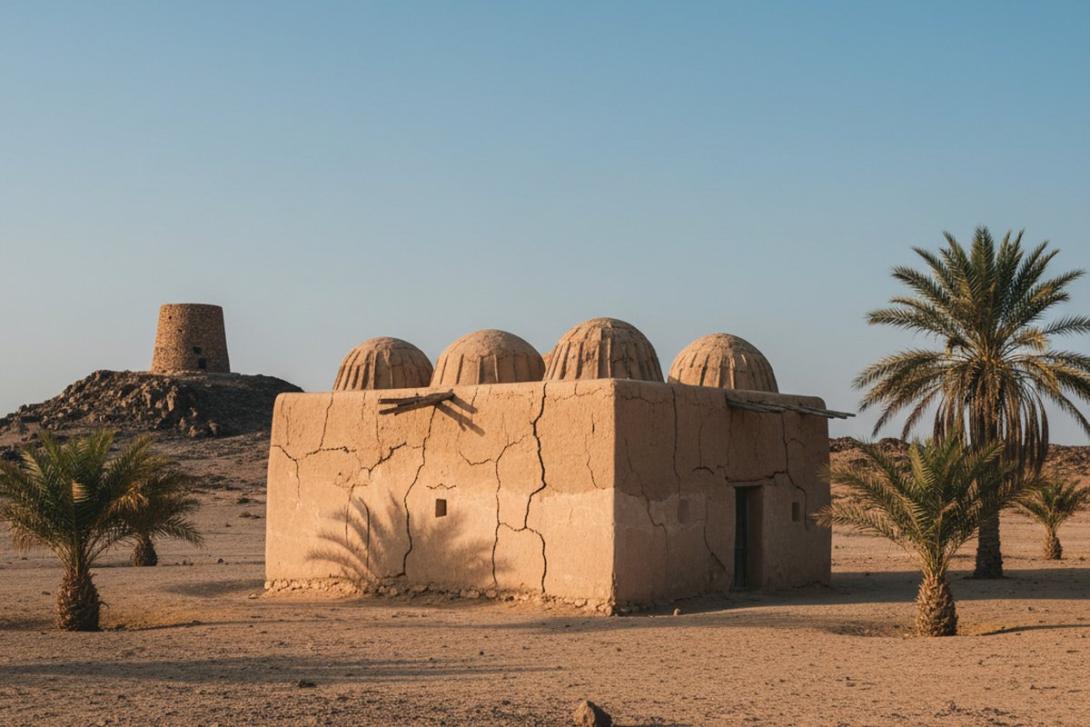
Al Bidya Mosque — also spelled Al Bidyah Mosque, locally known as the Ottoman Mosque — is the oldest known mosque still standing in the UAE. Radiocarbon dating points to a construction date around 1446 AD, and the small mud-brick building has been in continuous use for prayer ever since. It sits in the coastal village of Al Bidyah, around 35 km north of Fujairah city, paired with two fortified watchtowers on the hills behind it. Free to enter and quietly extraordinary, it is a natural counterpoint to the Sheikh Zayed Grand Mosque in Abu Dhabi.
At a Glance
| Field | Value |
|---|---|
| Location | Al Bidyah village, east coast of Fujairah |
| Built (estimated) | Late 15th century; radiocarbon dating suggests circa 1446 AD |
| Construction material | Hand-formed mud brick, coated with stone, gypsum, and local clay |
| Domes | Four small domes, each formed over leaning palm trunks |
| Capacity | Approximately 50–70 worshippers |
| Hours | Roughly 9 a.m. – 1 p.m. and 4 p.m. – 8 p.m.; closed during the five daily prayers |
| Admission | Free |
| Dress code | Modest — covered shoulders, knees, arms; women cover their hair |
| Distance from Fujairah city | ~35 km / 35 minutes by car |
| Distance from Dubai | ~140 km / 90–100 minutes via E311 and E84 |
| Best for | Heritage travellers, history readers, east-coast day-trippers |
History and Significance
Al Bidya is the oldest known mosque still standing in the UAE, and one of the oldest surviving mosques in the broader Lower Gulf. There is no contemporaneous foundation inscription; radiocarbon analysis has placed the construction date around 1446 AD as the earliest reliable estimate.
Dating
The 1446 figure comes from radiocarbon work on palm-trunk timbers and organic material embedded in the original walls and domes. The UAE has plenty of older settlements, forts, and tombs, but in terms of standing mosques in continuous religious use, nothing else on the country's territory has been reliably dated earlier — Al Bidya anchors the start of the visible Islamic-architectural record in the Emirates.
Construction
The mosque was built using the practical default for 15th-century coastal Fujairah: hand-formed mud bricks laid into thick walls — around 80 cm in places — coated with a render of stone, gypsum, and local clay. Wall thickness is partly structural (the walls carry the four domes) and partly climatic, providing thermal mass that keeps the interior cool. The local nickname "Ottoman Mosque" is misleading: the building predates Ottoman influence in this part of the Gulf, and its construction language is local rather than imported.
Restoration
By the late 20th century the mosque was structurally fragile. Fujairah's heritage authorities led a careful, conservative restoration that stabilised the walls and dome shells using compatible traditional materials. What you see today is the original 15th-century building, repaired rather than rebuilt. A small interpretive visitor centre was added alongside. The mosque is still an active place of prayer; interior access pauses during the five daily prayers and Friday afternoons.
The Architecture
The architectural interest is out of all proportion to the size — the structure occupies a footprint smaller than a modest village shop, and yet it solves the problem of roofing a mud-brick prayer hall in a way that has no parallel anywhere else in the UAE.
The Four Small Domes
The signature feature is the cluster of four small domes rising from the roof, supported internally by a single central column. The technique is the unusual part: rather than building a true masonry dome on pendentives, the builders leaned palm-trunk timbers inwards from the corners of each bay to form a rough vault, then packed mud and gypsum render over the wooden armature. The four-dome layout is itself unusual — most regional mosques of similar age have a single dome, a flat palm-frond roof, or no domes at all.
The Mihrab
The mihrab — the prayer niche pointing towards Mecca — is set into the qibla wall opposite the entrance. It is shallow, plain, and built from the same mud-brick fabric as the rest of the wall, with no carved decoration. This is a working village mosque, not a state monument; the architectural statement is in the structure rather than the ornament.
The Pulpit
The pulpit, or minbar, is a low set of carved stone steps built into the qibla wall beside the mihrab — steep, narrow, and reduced to its functional minimum.
The Ablution Area
A small ablution area sits adjacent to the prayer hall, with simple traditional washing facilities; the fittings have been updated to keep the building usable for daily worship. Inside the hall, a single central column rises from the floor to support the meeting point of the four domes overhead — the structural keystone of the building.
Watchtowers
Two small fortified watchtowers stand on the hills directly behind the mosque. They are not part of the mosque proper but were built in the same tradition and served as defensive positions for the village. A short walk up gives an aerial view of the mosque and the Gulf of Oman.
Visitor Experience
Most people spend 30 to 45 minutes here, longer with a walk up to the watchtowers. Allow time at the visitor centre to read the dating panels before going inside.
Dress Code
Modest dress is required for everyone going inside — covered shoulders, knees, and arms, with long trousers or a long skirt as the safe default. Women are expected to cover their hair before entering the prayer hall; men do not need a head covering. The visitor centre lends scarves to women without one.
Photography
Photography is allowed outside, and inside if you ask first and avoid flash. Photographing worshippers during prayer is discouraged. Drones require prior authorisation.
The Visitor Centre
A small interpretive centre sits next to the mosque with bilingual (Arabic and English) panels covering the building's history, the radiocarbon dating, and the dome-construction technique. It is the right place to start a visit.
Getting There
By Car
Al Bidyah village sits on the east-coast road around 35 km north of Fujairah city — roughly 35 minutes by car. The mosque is signposted from the main road; free parking sits outside the visitor centre.
From Dubai, take Sheikh Mohammed bin Zayed Road (E311) to Sheikh Khalifa Highway (E84), then north along the east-coast road to Al Bidyah — approximately 140 km, around 90 to 100 minutes outside peak hours. The drive crosses the Hajar Mountains and is one of the more scenic emirate-to-emirate routes in the country.
By Taxi or Ride-Hailing
A taxi from Fujairah city is roughly AED 80–120 one way. From Dubai, a ride-hail is normally AED 250–350 — at that level, self-drive is far more economical.
By Public Bus
Inter-emirate buses run from Dubai to Fujairah, then a local taxi up the coast. Total trip time is around three hours each way; most visitors drive.
Best Time to Visit
- November to March — peak season. Daytime temperatures of 20–28 °C make exploring the mosque, the watchtowers, and the coastline pleasant. Mornings are quietest; weekend afternoons get busier as Dubai day-trippers arrive.
- April and October — workable, but the climb up to the watchtowers gets hot midday. Aim for early morning or after 4 p.m.
- May to September — the mosque interior stays bearable thanks to thick mud-brick walls, but the open courtyard and watchtowers are uncomfortable. Visit before 10 a.m. or after 5 p.m.
- Friday — non-prayer access is restricted on Friday afternoons. Friday morning is usually fine.
- Ramadan — visiting hours shift; check locally before travelling.
Practical Notes
- Entry is free; no booking required
- Modest dress is required for everyone; scarves are available on loan for women at the visitor centre
- Shoes are removed before entering the prayer hall
- Photography is allowed outside, and inside if you ask first; no flash
- The mosque is closed during the five daily prayers and on Friday afternoons
- Allow 30–45 minutes for the mosque, longer with the watchtowers
- The watchtower trail is rough — closed shoes are sensible
- No on-site café; small restaurants are a short drive south in Al Aqah
- Free parking sits beside the visitor centre
- Partial wheelchair access — the mosque interior has a small threshold step; the watchtowers are not accessible
Compared with Sheikh Zayed Grand Mosque
Al Bidya and the Sheikh Zayed Grand Mosque are the two bookends of UAE Islamic architecture. The Grand Mosque in Abu Dhabi is the country's largest — a 12-hectare complex of white marble with capacity for around 40,000 worshippers, completed in 2007. Al Bidya is the opposite end of the same tradition: a hand-formed mud-brick village mosque from around 1446 AD with capacity for 70 people. Visiting both gives you the full historical span in a way no single building can.
Nearby
The mosque sits a short walk from Snoopy Island and the Al Aqah resort cluster — easy to combine into one east-coast day. Park once at Al Bidyah, visit the mosque and watchtowers, then walk or drive five minutes south for an afternoon snorkel. Fujairah Fort is around 35 minutes south, a natural heritage pairing. Dibba is 20 minutes north for lunch; Khor Fakkan with its waterfall and corniche is 25 minutes south on the coast road.
Frequently Asked Questions
What is Al Bidya Mosque?
Al Bidya Mosque, also spelled Al Bidyah Mosque and locally known as the Ottoman Mosque, is the oldest known mosque still standing in the UAE. It sits in Al Bidyah village on Fujairah's east coast and dates to around 1446 AD. The building remains in active use for prayer.
How old is Al Bidya Mosque?
It dates to the late 15th century, with radiocarbon analysis suggesting a construction date of around 1446 AD. Some sources cite a wider 15th-century range, but 1446 is the earliest reliable laboratory-supported date.
Is it really the oldest mosque in the UAE?
It is the oldest known standing mosque on the territory of the present-day UAE, with continuous use as a place of prayer.
How much does it cost to visit?
Entry is free. There is no charge to walk up to the watchtowers or to use the visitor centre.
What are the opening hours?
Approximately 9 a.m. to 1 p.m. and 4 p.m. to 8 p.m., closed during each of the five daily prayers. Friday afternoons are reserved for congregational prayer; Friday morning visits are usually fine. Hours shift during Ramadan.
Can non-Muslims visit Al Bidya Mosque?
Yes. Non-Muslim visitors are welcome at non-prayer times. Modest dress is required for everyone, and the visitor centre lends scarves to women without a head covering.
What is the dress code?
Covered shoulders, knees, and arms, with long trousers or a long skirt as the safe default. Women are expected to cover their hair before entering the prayer hall.
How do I get there from Dubai?
Drive Sheikh Mohammed bin Zayed Road (E311) to Sheikh Khalifa Highway (E84), then north along the east-coast road to Al Bidyah. Around 140 km and 90 to 100 minutes outside peak hours.
How does it compare to Sheikh Zayed Grand Mosque?
They are the two bookends of UAE Islamic architecture. Sheikh Zayed Grand Mosque (completed 2007) is the country's largest, with capacity for around 40,000 worshippers. Al Bidya (around 1446 AD) is the smallest historically significant mosque, with capacity for about 70 people.
Are the watchtowers worth the climb?
Yes, especially in the cooler months — the short walk gives a clear view of the mosque, the village, and the coastline. Wear closed shoes; avoid midsummer afternoons.