Car Accident in the UAE: Reporting by Emirate and the Insurance Claim
Updated Sources Dubai Police, Abu Dhabi Police
Update · 3 October 2026
Not stopping after an accident that injures someone carries up to one year's imprisonment and a fine of AED 50,000 to 100,000, or either, under Article 38 of Federal Decree-Law 14/2024 (in force since 29 March 2025): the law's binding Arabic text says one year, where its English translation says two.
Read the full update
A Rafid accident report in Sharjah is valid for 30 days, and whether a storm or flood claim falls under the unified policy's natural-disaster exclusion turns on an official decision, as the policy's own wording sets out. Abu Dhabi has taken minor-accident reports through the Saaed app or 800 72233 since 1 August 2024.
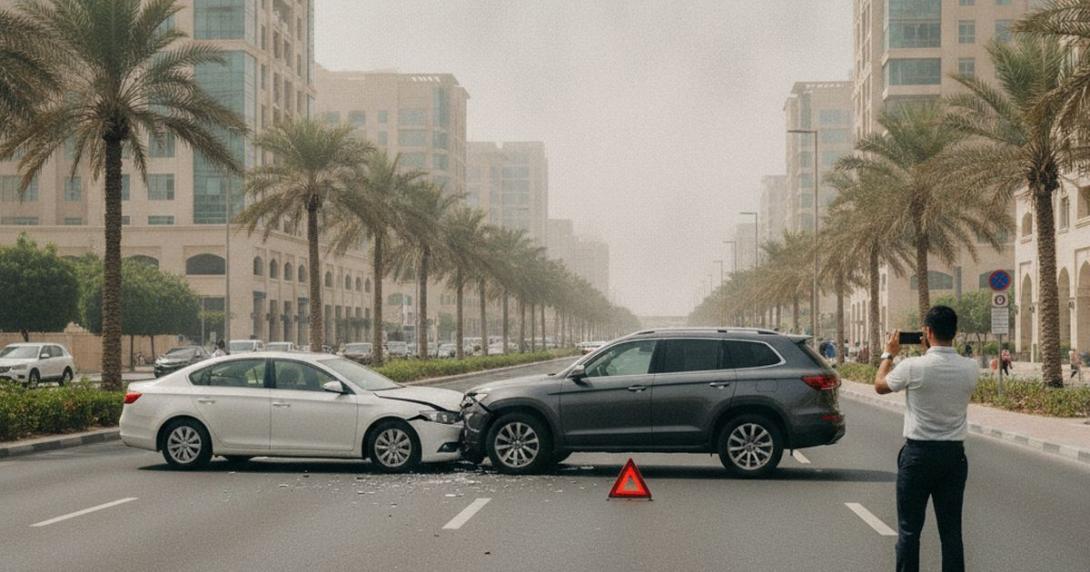
After a minor car accident in the UAE you do not wait for a patrol car: you move the vehicles out of traffic (leaving them in the lane can be fined AED 1,000 and 6 black points as stopping in the middle of the road without a justified reason), then self-report through your emirate's channel — the Dubai Police app in Dubai, the Saaed app or 800 72233 in Abu Dhabi, the Rafid app or 80092 in Sharjah, and the MOI UAE app or 999 in the northern emirates. The police report that comes back — commonly called green if you are not at fault, red/pink if you are, white if the culprit is unknown — is the document your insurer builds the entire claim on, and it has a shelf life: 3 months for a Dubai Police report, 30 days (renewable) for a Rafid report in Sharjah. If anyone is hurt, none of the app flows apply: call 999 for police and 998 for an ambulance (see our UAE emergency care guide) and do not move the vehicles.
At a Glance
| Situation / Emirate | Channel | Number | Fee |
|---|---|---|---|
| Anyone injured, anywhere | Police + ambulance attend | 999 / 998 | — |
| Dubai — minor accident | Dubai Police app (also police stations, 7:30am–10pm) | 901 (non-emergency) | At fault AED 520; unknown party AED 420; not at fault free |
| Abu Dhabi — minor accident | Saaed app or Saaed operations room (since 1 Aug 2024) | 800 72233 | Not published — confirm in the app |
| Sharjah — minor accident | Rafid app or hotline | 80092 | AED 385 by app; AED 440 with a Rafid officer; AED 335 unknown party |
| Ajman, RAK, UAQ, Fujairah | MOI UAE app or police patrol | 999 | Confirm in the MOI app |
| Report validity for insurance | Dubai; Sharjah | — | 3 months (Dubai Police); 30 days, renewable (Rafid) |
The First 10 Minutes: Safety, Then Move the Cars
The sequence in the first minutes decides both your safety and your claim:
- Stop. Driving off after causing even a small accident costs AED 500, 8 black points and a 7-day impound for a light vehicle on the federal violations list, and not stopping when an accident injures someone is a crime under Article 38 of Federal Decree-Law 14/2024: up to one year's imprisonment and a fine of AED 50,000 to 100,000, or either. Even for a scratch, drive off and it stops being a fender-bender.
- Check for injuries. Any injury at all: call 999 (police) and 998 (ambulance), switch on hazard lights, and leave the vehicles exactly where they are. Fault reconstruction in injury cases uses the final positions.
- No injuries, cars drivable: photograph, then move. Take wide shots showing both cars' positions and the road, then close-ups of the damage and both plates. Then move the cars to the shoulder or the nearest safe area. Leaving them in the lane can be fined as stopping in the middle of the road without a justified reason — AED 1,000 and 6 black points on the federal violations list, which Abu Dhabi Police say they apply to drivers who do not move to the nearest safe place.
- Exchange details. The other driver's name, phone number, plate number, and a photo of their driving licence and Mulkiya (registration card) cover everything the apps will ask for.
- Stand clear. The official UAE government guidance is to wait at least 15 metres away from your car — secondary collisions on fast roads are the classic second accident.
Do not agree to "settle in cash and skip the report". Under Federal Decree-Law 14/2024, no garage may repair a vehicle with signs of accident damage without a repair permit from the traffic authorities (Art. 28), and every driver must report an accident to the police or an approved party within three hours (Art. 5).
Reporting a Minor Accident: Dubai
In Dubai, minor collisions without injuries are reported in the Dubai Police app:
- Open the Dubai Police app and sign in with UAE Pass.
- Choose "Minor Traffic Accident Report".
- Enter the plate number and emirate for every vehicle involved, plus driver licence details.
- Photograph the damage — at least 4 clear angles taken at the scene; take the wide shots before the cars are moved.
- Submit. Dubai Police give the service time as one working day.
No smartphone? Dubai Police also issue minor-accident reports at police stations, open 7:30am to 10pm. If the drivers disagree, Dubai Police ask you to contact the relevant police station. For non-emergency questions, Dubai Police answer on 901.
Fees: the at-fault driver pays AED 520 for the report; a report against an unknown vehicle (you found your parked car hit) is AED 420; the not-at-fault driver pays nothing.
Reporting a Minor Accident: Abu Dhabi (Saaed)
Since 1 August 2024, Abu Dhabi Police have directed drivers to report minor accidents through the Saaed app (often spelled Saeed), run by Saaed for Traffic Systems with the General Command of Abu Dhabi Police, or by calling Saaed's operations room — and to call 999 when someone is injured. The flow: move the cars off the road, open the app, choose "Report accident", confirm your phone number (the app auto-detects the location), state whether both drivers agree on fault, then upload photos of both licences, both Mulkiyas, and the damage. You get a confirmation number, and the report reaches the insurers electronically.
If you can't use the app, the Saaed operations room answers on 800 72233 and can dispatch a patrol; injuries still mean 999. Report copies are retrievable on saaed.ae ("Accident Report" inquiry with your report number), via the Abu Dhabi Police website or TAMM. Saaed's reports are paid, but neither Saaed nor Abu Dhabi Police publishes a current fee that we could find, so confirm the amount in the app before paying. If you dispute the fault finding, raise it with Saaed straight away: it matters for the claim (more below).
Reporting a Minor Accident: Sharjah (Rafid)
Sharjah outsources minor-accident response to Rafid (Rafid Automotive Solutions, a Sharjah Asset Management company) working with Sharjah Police. Two routes:
- Rafid app: register with your mobile number, choose "Accident Reporting", state whether both parties agree on who's at fault, let the app take your location, enter each vehicle's plate and traffic-code details, upload licences, Emirates IDs and damage photos, and pay the fee.
- Call 80092 — a unit attends, documents the scene, and issues the report. It operates 24/7.
Rafid's published fees are AED 385 for a two-vehicle accident reported in the app, AED 440 when a Rafid officer attends or you report through another channel, and AED 335 for an unknown-party report — confirm on rafid.ae or in the app before paying. A Rafid report is valid for 30 days; renew it before it expires if your claim needs longer. You can check a report's status in the app with your accident number, or through the 80092 call centre. If you commute across the border daily, note which emirate's system applies: it is always where the collision happened, not where the car is registered.
Ajman, Ras Al Khaimah, Umm Al Quwain, Fujairah
The northern emirates use the MOI UAE app (Ministry of Interior): sign in with UAE Pass, choose "Issue a minor traffic accident report", confirm the location pin, enter both vehicles' details, attach damage photos, and receive the report as a smart notification. If the app rejects the case as non-minor, or the other driver won't cooperate, call 999 — operators route to the correct emirate's police, and a patrol attends and issues the report at the scene.
When Police Must Attend (No App Allowed)
Self-reporting is only for genuinely minor cases. A patrol must come — call 999 — when any of these apply:
- Injury or death, however slight the injury seems.
- Fault is disputed and the drivers cannot agree (in Dubai and Sharjah the apps ask this up front; a disagreement routes the case to an officer or an attended report).
- Government or third-party property is damaged — lamp posts, barriers, signage, landscaping.
- A driver has no licence, no insurance, or no plates, or refuses to share details.
- Suspected intoxication. Dubai Police's minor-accident report service excludes an accident where a driver was under the influence of alcohol, and under Federal Decree-Law 14/2024 (Art. 40) causing a death while driving under the influence carries at least one year's imprisonment and a fine of at least AED 100,000, or either.
- A vehicle is undrivable or the accident blocks a highway.
In these cases, leave the vehicles in place unless police instruct otherwise, and let the patrol document positions.
Green, Red/Pink, White: What the Report Colour Does to Your Claim
The report records one of three outcomes, usually referred to by colour, and insurers act on it mechanically:
| Report | Meaning | What happens at claim time |
|---|---|---|
| Green | You are not at fault | Repair is claimed from the at-fault driver's insurer (third-party claim). No excess is charged to you, and your no-claims record is untouched. The unified third-party policy also entitles you, as the owner of a private car, to a loss-of-use allowance at the rental rate of a similar car, capped at AED 300 a day for up to 15 days, while yours is repaired (the insurer may provide a similar substitute car instead); there is no allowance if you take cash instead of the repair. |
| Red / Pink | You are at fault | Your own comprehensive policy repairs your car (minus the excess); your insurer pays the other party. On third-party-only cover, your car's damage is entirely your own cost. You also pay the report fee (AED 520 in Dubai). |
| White | Fault undetermined / culprit unknown | Hit-and-run and parked-car cases. Comprehensive cover pays for your repair, normally with the excess applied; third-party-only pays nothing for your own car. |
The colour terminology drifts between "red" and "pink" depending on the insurer and emirate — the meaning is identical. If you believe the fault call is wrong, act fast: in Abu Dhabi, raise it with Saaed; Rafid takes disputes within 72 hours of the report, at a Rafid centre or through its app; and in Dubai, Dubai Police send disagreements to the relevant police station. Do this before repairs start — once the cars are fixed, the evidence is gone.
The Insurance Claim, Step by Step
The claim itself is governed by the Central Bank of the UAE's unified motor insurance policies (Insurance Authority Board Decision 25/2016, now administered by the CBUAE):
- Notify your insurer immediately — the unified policy requires you to notify the authorities immediately and the insurer promptly, without unjustifiable delay. The report has a validity — 3 months for a Dubai Police report, 30 days (renewable) for a Rafid report — and repairs should be completed inside it or you may need to renew it.
- Submit the report + documents: the accident report (the PDF from the app is accepted), your licence, Mulkiya, and photos. On a green report you file against the other party's insurer; some comprehensive policyholders let their own insurer handle it and recover.
- Excess (deductible): at-fault comprehensive claims carry the excess on your policy schedule — capped by the unified policy at AED 350 to AED 1,400 per accident for a private car, depending on its value. The unified policy also caps the additional deductibles insurers may charge: at most 10% of the compensation for a driver under 25 and for taxis and public transport, 15% for sports cars and modified vehicles, and 20% for vehicles modified outside the factory and for rental cars — check which apply on your schedule.
- Agency vs non-agency repair: when the other driver's insurer pays, the unified third-party policy requires a car in its first year of registration to be repaired at the agency with new original parts and no depreciation deduction; after that, the insurer may use suitable garages and non-original parts of the same grade, unless your own comprehensive policy includes agency repair. On your own comprehensive cover, agency repair is a term agreed in the policy; without it the insurer directs you to its approved garages. You are entitled to have the finished repair checked by an approved vehicle-testing centre (a Tasjeel-type facility) if you doubt the workmanship.
- Settlement clock: Insurance Authority Board Decision 25/2016 requires claims to be settled within 15 days of complete documents, with any missing documents flagged within three days; on a total loss, a delay beyond 15 days without convincing justification obliges the insurer to compensate you for the costs of being deprived of the vehicle.
- Total loss: under the unified comprehensive policy, the car is a total loss when repair costs exceed 50% of its pre-accident value (or the chassis or pillars need cutting or welding), and the insurer pays the insured value less a 20% depreciation deduction and the share of the insurance period already used. If that happens, the registration must be cancelled with your emirate's traffic department.
Comprehensive vs third-party at claim time is stark: on a red report, a comprehensive policyholder pays the excess; a third-party-only policyholder pays for their entire own repair. Accident history also follows the car: a recorded claim shows up when you sell, which is exactly what buyers check before agreeing a price.
Hit-and-Run and Uninsured Drivers
The other car drove off: do not chase it. Photograph or memorise the plate, note colour/make/direction, and call 999 (or file the unknown-accident report in your emirate's app — AED 420 in Dubai, around AED 335 via Rafid in Sharjah). Police pull camera footage on major roads surprisingly often. With a white report, comprehensive cover pays for your repairs (excess applies); third-party-only does not cover your own car. For the fleeing driver, not stopping after causing even a small accident costs AED 500, 8 black points and a 7-day impound, and if anyone was injured, Article 38 of Federal Decree-Law 14/2024 allows up to one year's imprisonment and a fine of AED 50,000 to 100,000, or either.
The at-fault driver is uninsured: the police report still assigns fault, and you (or your comprehensive insurer, which then recovers) pursue the driver directly — through a civil claim if needed. Driving without insurance is itself a fined violation with vehicle impoundment under the traffic law. There is no state compensation fund for vehicle damage, so an uninsured at-fault driver on your green report means either their wallet or the courts.
Rain and Flood Claims (December–April)
The UAE's rain season — roughly December to April, with the April 2024 storms as the extreme case — produces a claims pattern of its own. The unified comprehensive policy excludes accidents related to "natural disasters such as floods, tornados, hurricanes", but it defines a natural disaster as a natural event causing extensive and widespread damage "in respect of which a decision is issued by the concerned authority in the country" — so whether the exclusion applies turns on an official decision, not on the weather alone. Policies and natural-perils extensions differ, so check the "natural perils / Act of God" line on your schedule rather than assuming.
The conditions that decide flood claims in practice:
- The car must have been parked or driven in a recognised, permitted location — public roads, designated parking. Deliberately driving into a flooded underpass, wadi or flood channel is treated as negligence and is not covered.
- Do not restart a flooded car. Engine hydrolock from a restart attempt is the difference between an electrical claim and an engine replacement.
- Third-party-only policies pay nothing for your own flood damage, full stop.
Even for pure weather damage (no collision), the unified policy requires you to notify the authorities immediately and your insurer promptly; ask your insurer which documents it needs.
Frequently Asked Questions
What should I do after a minor car accident in Dubai?
If no one is hurt: photograph the scene and both plates, move the cars out of traffic (leaving them in the lane can cost AED 1,000 and 6 black points), exchange licence and Mulkiya details, then file the report in the Dubai Police app under "Minor Traffic Accident Report". Dubai Police give the service time as one working day. Any injury: call 999 and 998 and leave the cars in place.
Do I have to report even a tiny scratch?
Yes. Federal Decree-Law 14/2024 requires a driver to report any accident to the police or an approved party within three hours (Art. 5), and garages may not repair accident damage without a repair permit from the traffic authorities (Art. 28). Private cash settlements at the roadside leave you exposed if the other driver later reports it — and driving off after causing even a small accident costs AED 500, 8 black points and a 7-day impound.
How much does a Dubai Police accident report cost?
The at-fault driver pays AED 520. A report for damage by an unknown vehicle costs AED 420. The not-at-fault (green report) driver pays nothing.
What do the green and pink accident reports mean?
By the usual convention, green means you are not at fault — the other side's insurer pays for your repair. Red/pink means you are at fault — your comprehensive policy (minus excess) or your own pocket pays. White means fault was not determined or the culprit is unknown — comprehensive cover pays with excess applied.
How do I report an accident in Abu Dhabi — what is Saaed?
Saaed (Saeed) is the traffic-services company that handles minor accidents for Abu Dhabi Police. Since 1 August 2024 Abu Dhabi Police have directed drivers to report minor accidents in the Saaed app or to Saaed's operations room on 800 72233, and to call 999 if someone is hurt. Move the cars off the road first: stopping in a lane without justification costs AED 1,000 and 6 black points.
What is Rafid in Sharjah and what does it cost?
Rafid is Sharjah's accident-response operator. Report minor accidents via the Rafid app or call 80092, 24/7. Rafid charges AED 385 for a two-vehicle accident reported in the app, AED 440 when its officer attends, and AED 335 for an unknown-party report; the report is valid for 30 days.
How long is a police report valid for an insurance claim?
It depends on who issued it: a Dubai Police report is valid for 3 months from issue, a Rafid report in Sharjah for 30 days (renewable before it expires). Complete repairs within that window, and notify your insurer within 24–48 hours regardless — late notification is a standard reason for claim friction.
What happens if the other driver drives away?
Note the plate and call 999 or file an unknown-accident report in your emirate's app. You'll receive a white report; comprehensive insurance covers your repair with the excess applied. If anyone was injured, the fleeing driver faces up to one year's imprisonment and a fine of AED 50,000 to 100,000, or either, under Federal Decree-Law 14/2024 (Art. 38); for damage only, not stopping costs AED 500, 8 black points and a 7-day impound.
Related reading: new to driving here? Start with converting your licence — the same guide covers Salik and traffic fines — and keep the 998 emergency-care numbers saved.
Sources
The pages this guide is based on, official ones first, and when each was last checked against it.
-
Dubai Police The minor-accident report — for accidents without injuries, AED 500 plus AED 20 charged to the liable party, the app or a police station (7:30am–10pm), one working day, disagreements to a police station, valid for 3 months; read from the service data behind the Dubai Police website
-
Dubai Police The unknown-party report — AED 400 plus AED 20, valid for 3 months; read from the service data behind the Dubai Police website
-
Abu Dhabi Police Minor accidents reported through the Saaed app or Saaed's 800 72233 from 1 August 2024, 999 when someone is injured, and AED 1,000 and 6 black points for not moving the car to a safe place
-
Rafid Sharjah's report fees (AED 385 by app, AED 440 with an officer, AED 335 unknown party), the 30-day validity and renewal, disputes within 72 hours, and the 80092 line
-
Rafid The official minor-accident reporting service in Sharjah, open 24/7
-
UAE Government Portal The apps for reporting minor accidents (MOI UAE, Saeed, Abu Dhabi Police, Dubai Police, Rafid) and the traffic law in force since 29 March 2025
-
UAE Government Portal 999 for police and 998 for an ambulance, moving a minor-accident car to the shoulder and waiting at least 15 metres away, and leaving the vehicles where they are if anyone is hurt
-
Ministry of Interior The federal violations list (Ministerial Resolution 178/2017) — not stopping after causing a small accident (AED 500, 8 black points, 7-day impound for a light vehicle), stopping in the middle of the road without a justified reason (AED 1,000, 6 black points) and driving without insurance
-
UAE Legislation Federal Decree-Law 14/2024 — reporting an accident within three hours (Art. 5), no repair without a repair permit (Art. 28) and the penalty for causing a death under the influence (Art. 40); read from the Wayback Machine's capture of 3 Aug 2025
-
UAE Legislation The Arabic text of Federal Decree-Law 14/2024, which prevails — Art. 38 sets up to one year's imprisonment and a fine of AED 50,000 to 100,000, or either, for not stopping after an accident that injures someone; read from the Wayback Machine's capture of 11 Aug 2025
-
CBUAE Insurance Authority Board Decision 25/2016 — claims settled within 15 days of complete documents, missing documents flagged within three days, and compensation for delay on a total loss
-
CBUAE The unified comprehensive policy — deductible caps of AED 350–1,400 for private cars, the additional-deductible caps, the 50% total-loss rule with its 20% deduction, the natural-disaster definition and exclusion, the duty to notify, and the right to have a repair checked
-
CBUAE The unified third-party policy — no deductible for the injured party, first-year agency repair with new original parts, and the loss-of-use allowance of up to AED 300 a day for up to 15 days, or a substitute car
Spotted something out of date? Tell us, and we re-check it against the source.
General information based mainly on official public sources, not legal, immigration, tax, financial or medical advice. Rules and fees change: confirm with the relevant authority or a qualified professional before acting. See our Terms of Use.