Landlord Maintenance Responsibilities in Dubai: Who Pays for Repairs and How to Escalate
Updated Sources Dubai Legislation Portal: Law No. 26 of 2007 regulating the relationship between landlords and tenants, Dubai Legislation Portal: Law No. 33 of 2008 amending Law No. 26 of 2007
Short answer
In a Dubai rental, the landlord is responsible for maintenance and for fixing any fault that affects your use of the home as intended, unless your tenancy contract says otherwise (Article 16 of Law No. 26 of 2007). The landlord also answers for damage and wear you had no hand in (Article 17). You pay for damage you cause, look after the home as an ordinary person looks after their own (Article 19), and do the upkeep your contract or custom puts on tenants. Report the fault in writing. If the landlord won't act, file at the Rental Disputes Centre (RDC), and keep paying the rent while you do.
- Default rule
- The landlord maintains and repairs
- Law No. 26 of 2007: Article 16 (unless the contract says otherwise) and Article 17
- Your share
- Damage you cause, ordinary care, agreed or customary upkeep
- Articles 17 and 19; Civil Transactions Law, Article 716
- If refused
- A case at the Rental Disputes Centre
- AED 500 for a maintenance request with no stated value
- Power or water cut
- Not allowed: the police and an urgent RDC application
- Article 34; the RDC's FAQ (Urgent Matters Judge)
This guide is for tenants renting a home in Dubai whose AC, water heater, plumbing or appliances need fixing, or whose landlord doesn't answer. It follows Dubai's tenancy law, Law No. 26 of 2007 as amended by Law No. 33 of 2008. The RDC hears rent disputes across Dubai, free zones included, except in free zones with their own rent tribunals and for lease-finance and long-term leases (Decree No. 26 of 2013, Article 6). Deposit deductions, repainting charges at move-out and the RDC's filing steps are in Dubai rental disputes; if you are new to renting here, start with renting in Dubai. The guide is part of the property guide.
At a Glance
| Problem | Usually whose to fix | What decides it |
|---|---|---|
| AC stops cooling | Landlord, if you didn't cause the fault | Article 16 and your contract's maintenance clause; Article 17 |
| Water heater leaks or fails | Landlord, if you didn't cause the fault | Article 16 and your contract; Article 17 |
| A leak, damp, or mold from a leak | Landlord, if you didn't cause the leak: the leak and the damage it did to the home | Articles 16 and 17 |
| Appliances that came with the home | Check the contract and the inventory; the RDC decides disputes | Your contract; Article 2 covers fittings |
| Something you broke | You | Article 17; Civil Transactions Law, Article 716 |
| Pests when you moved in | Landlord, as a handover defect | Article 15 |
| Pests that appear later | Depends on the cause and the contract | Articles 16, 17 and 19 |
| Repainting after you move out | The owner, by custom, says the RDC's FAQ | RDC FAQ; deposit disputes in Dubai rental disputes |
| Landlord cuts power or water | Not allowed | Article 34 |
Your Contract Comes First
Article 16 makes the landlord's duty subject to the words "unless otherwise agreed by the parties". So first read the maintenance clause of your tenancy contract and any addendum you signed. If it puts routine servicing, small fittings or repairs up to an amount on you, that part is yours. The law itself sets no amount: no "minor repairs under AED X" rule appears in Articles 15 to 19. If the contract says nothing about maintenance, Article 16's default applies: the landlord maintains and repairs, apart from the upkeep custom puts on tenants.
Article 19 says the tenant's duty to carry out "the restorations that have been agreed upon or which are customary for Tenants to undertake" still stands. The law doesn't list which repairs are customary; when you and the landlord disagree, the RDC decides.
Article 17, which makes the landlord responsible for damage and wear you had no hand in, has no "unless otherwise agreed" words. The sources we read don't say how the RDC weighs a contract clause against it.
What the Landlord Owes
At handover. Article 15, as rewritten by Law No. 33 of 2008, binds the landlord "to hand over the Real Property in a good condition which allows the Tenant to fully use it as stated in the Lease Contract". Report a fault you find in the first days, such as an AC that doesn't cool or an infestation, in writing at once, with photos.
During the tenancy. Article 16: unless otherwise agreed, the landlord is "responsible for the Real Property's maintenance works and for repairing any defect or damage that may affect the Tenant's intended use of the Real Property".
Damage you had no hand in. Article 17 bars the landlord from making changes that impair your use of the home as intended, and makes the landlord responsible "for any defect, damage, deficiency, and wear and tear occurring to the Real Property for reasons not attributable to the fault of the Tenant". The Arabic text, which prevails, speaks of a cause in which the tenant had no hand.
The RDC's split. The RDC's FAQ divides maintenance into two kinds. Maintenance that affects your use of the home as intended (the English version calls it "required maintenance") is the landlord's. Maintenance that doesn't affect that use is the tenant's; the English says "typically", while the Arabic says the tenant is obliged to do it.
No deadline. Articles 15 to 19 set no time limit for a repair. So give the landlord a clear date in writing, and keep the record. The law's definition of "Landlord" includes whoever acts for the landlord or legally represents them (Article 2), so an agent or property manager who acts for the landlord counts; if you're not sure they still do, copy the landlord too.
Major works. If the property needs restoration or comprehensive maintenance that can't be done with you inside, the landlord can seek eviction at the end of the lease, with at least 12 months' notice through the Notary Public or by registered mail and a technical report issued or approved by Dubai Municipality (Article 25(2)(b)); see Dubai rental disputes.
What You Owe
Article 19 asks three things of you:
- pay the rent on the due dates;
- maintain the home "in such a manner as an ordinary person would maintain his own property";
- make no changes, restorations or maintenance works without the landlord's permission and the licenses the authorities require. This doesn't affect your duty to carry out the restorations your contract or custom puts on you.
Damage you cause is yours: Article 17 covers only damage you had no hand in. Under Article 25(1)(e), damage from a deliberate act or gross negligence, letting others cause such damage, or a change that endangers the property's safety and can't be undone, lets the landlord seek eviction before the lease ends.
The federal Civil Transactions Law (Federal Decree-Law No. 25 of 2025), in force since 1 June 2026, sets similar general rules for leases. The tenant must care for the home as an ordinary person would and is liable for damage from a cause attributable to them (Article 716). The tenant makes the minor repairs custom requires, unless otherwise agreed, and keeps the home clean (Article 719). The tenant tells the landlord promptly when the home needs urgent repairs or a defect appears, unless you can prove the landlord knew or must have known (Article 721). The law doesn't apply to facts and acts before it took effect, unless it provides otherwise (Article 4(1)).
Common Problems, Case by Case
AC that stops cooling
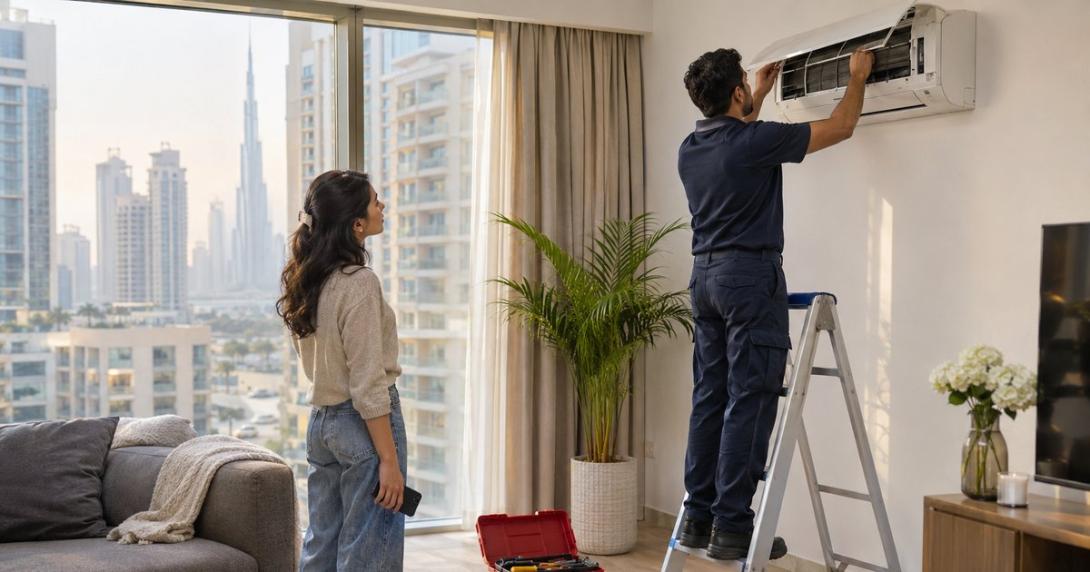
An AC that stops cooling affects your use of the home, which makes it maintenance the landlord owes under Article 16, unless your contract moves it to you or the fault came from misuse. If your contract assigns routine servicing, such as filter cleaning, to you, that part is yours. In a tower on district cooling, the chiller bill is a separate matter (see utilities setup); your repair request still goes to your landlord.
Water heater
A water heater that leaks or stops heating affects your use of the home. It is the landlord's to fix under Articles 16 and 17 unless you caused the fault; if your contract moves water-heater repairs to you, see Your Contract Comes First above. If it is leaking, turn off its water and power, photograph it, and report it in writing the same day as urgent.
Leaks, damp and mold
Neither Law No. 26 of 2007 nor the lease chapter of the federal Civil Transactions Law mentions mold. They cover the cause: a leaking pipe, a blocked AC drain, water coming in from outside or from the flat above. Article 17 makes the landlord responsible for damage to the home "not attributable to the fault of the Tenant", so repairing the leak and the damage it did to the home, mold included, is the landlord's. Ask the landlord in writing to find and fix the source. Article 17 speaks of damage to the property; the texts we read don't settle when a landlord must also pay for your own belongings, so claim that at the RDC with your evidence. If the landlord says the damp came from how you use the home, that is a dispute of fact for the RDC; your evidence is dated photos, the date you first reported it, and the technician's report.
Appliances that came with the home
Article 2 defines the property the law covers as the immovable property "and everything attached or annexed to it", so built-in fittings are part of what you rent. For loose appliances, such as a washing machine or a fridge, check whether the contract or the inventory you signed lists them. If it does, report a fault from normal use to the landlord like any other defect. Neither Dubai's law nor the lease chapter of the Civil Transactions Law says who repairs appliances, so a dispute over who pays goes to the RDC. An appliance you bought is yours; for a fault, see consumer complaints.
Painting
Repainting for looks during the tenancy doesn't affect your use of the home; agree it with the landlord in writing first (Article 19). Paint damaged by a leak is part of the leak damage. At the end of the tenancy, the RDC's FAQ says custom puts comprehensive cleaning and repainting of the interior walls after the tenant leaves on the owner, not the tenant (the English version says "typically").
Pests
An infestation present when you moved in points to a handover defect under Article 15, which requires the home to be handed over fit for use. The law doesn't name pests, so report it in writing at once; if the landlord disputes it, the RDC decides. One that starts later depends on the cause and your contract: Article 17 puts on the landlord damage you had no hand in, and Article 19 puts ordinary care of the home on you. Whoever pays, use a company on Dubai Municipality's list of licensed pest-control companies. The Municipality's own pest-control service, as its page describes it, covers public areas and facilities and UAE nationals' homes, among others; the page doesn't say whether it serves rented homes.
How to Get It Fixed
- Read the clause. Check whether your contract or an addendum moves this kind of repair to you.
- Report it in writing. Email or message the landlord, or the agent who acts for them: what is wrong, since when, and how it affects your use of the home. Cite Articles 16 and 17 of Law No. 26 of 2007 and ask for the repair by a date. Mark it urgent if it is. The RDC's FAQ says WhatsApp messages and email are admissible as evidence, provided the parties are questioned about them and acknowledge them in the case record.
- Keep the evidence. Dated photos and videos, your move-in inspection report, the technician's report, and receipts for anything you had to spend.
- Let the repair in. Under Article 707 of the Civil Transactions Law, a tenant may not prevent the landlord from carrying out repairs needed to preserve the property. If the works disrupt your use of the home, wholly or partly, the same article lets you ask, depending on the circumstances, for a lower rent or for the lease to end; ask the RDC, and keep paying the rent meanwhile. Staying until the work is finished ends the right to ask for the lease to end.
- Send one final reminder, then file. Send it in a form you can prove: Dubai's law defines a notice as written and sent through the Notary Public, by registered mail, by hand or by an approved electronic means (Law No. 33 of 2008, Article 2). Don't hold back an urgent problem to finish these steps.
If the Landlord Won't Fix It: the Rental Disputes Centre
The RDC is the Dubai Land Department's rent tribunal (Decree No. 26 of 2013). Where the landlord neglects maintenance that affects your use, its English FAQ says "the tenant may have recourse options, such as terminating the contract, reducing the rent, or conducting the repairs themselves and deducting the costs from the rent". The Arabic version, which we follow where the two differ, lists the same three options without the English "such as": the tenant "may" end the contract, reduce the rent, or repair the fault and deduct the cost, if the landlord doesn't carry out this maintenance. Neither version says how a tenant uses these options or whether an RDC order is needed first, and the RDC doesn't give legal advice.
Don't act on any of the three on your own. Under Article 7 of Law No. 26 of 2007, a valid lease can't be ended by one side during its term except by mutual consent or in accordance with that law, and paying less than the rent can be an eviction ground (Article 25(1)(a)). The safe course is to ask the RDC for the order you want: that the landlord carry out the repair, that the rent be reduced, that the lease be ended, or that you may repair and deduct a set amount.
Fees, from the RDC's FAQ:
| What you ask for | Fee |
|---|---|
| A maintenance request with no stated value | AED 500 |
| A money claim, such as costs you paid | 3.5% of the amount claimed, minimum AED 500, maximum AED 15,000 |
| Ending a running lease | 3.5% of the annual rent (or of the contract value if the lease isn't for one year), minimum AED 500, maximum AED 20,000 |
Smaller charges come on top: AED 100 for serving the case, AED 10 each for the knowledge and innovation fees, and AED 25 to register a power of attorney if you use one. Filing at a real estate services trustee center adds a service-partner fee, given as AED 130 + VAT in the FAQ's fee list (another answer gives AED 100). If the case settles at conciliation, half the court fee for the basic claim is refunded. The RDC's document list starts with your latest Ejari tenancy contract; without a contract, the FAQ says you can still file by adding a request to prove the tenancy (AED 500). Filing steps and appeals are in Dubai rental disputes.
Keep paying the rent. Nothing in Law No. 26 of 2007 lets you stop paying while a repair is outstanding. Article 25(1)(a) lets the landlord seek eviction if you fail to pay "the Rent or any part thereof" within 30 days of a notice to pay, served through the Notary Public or by registered mail, unless your contract says otherwise. If the landlord refuses your rent, the RDC's FAQ says to deposit it with the RDC under its "deposit and offer" procedure; you count as having paid from the date the judge accepts the request.
Can You Fix It Yourself and Deduct the Cost?
Don't deduct anything from the rent on your own. The rules point in different directions, and a short payment can be an eviction ground (Article 25(1)(a)).
- Dubai's law. Article 19 bars you from carrying out maintenance works without the landlord's permission and the required licenses. Failing to meet an obligation under the law or the contract within 30 days of the landlord's notice is itself an eviction ground (Article 25(1)(h)).
- The RDC's FAQ. Both versions list repairing and deducting the cost among the tenant's options, without saying how or whether an RDC order is needed.
- The federal Civil Transactions Law, in force since 1 June 2026. If the landlord, after formal notice, delays a necessary repair, the tenant may get the court's permission to do it and deduct the cost from the rent (Article 705(2)). For urgent or minor repairs the landlord owes, the tenant may do the work without the court's permission if the landlord, after formal notice, doesn't act within a reasonable time, and deduct the cost from the rent (Article 705(3)). Whether this reaches a Dubai tenancy is unsettled (see below); it is not leave to pay less rent on your own.
- How they fit together. The same law says a later general provision doesn't repeal or amend a special one unless the legislation expressly says so, and the special provision applies, in the matters it covers, where the two conflict (Article 4(3)). It also doesn't apply to facts and acts before 1 June 2026, unless it provides otherwise (Article 4(1)). The texts we read don't say whether Dubai's Article 19 prevails over Article 705(3), or how the RDC applies Article 705 to a Dubai tenancy.
The safe routes are the landlord's written agreement, naming the work and the amount you may deduct, or an RDC order. If the landlord permits a repair to maintain the home, the Civil Transactions Law lets you claim back from the landlord what you spent, within customary limits, even without a reimbursement clause (Article 709(1)). That is a claim against the landlord, not leave to deduct from the rent, and work done for your own benefit gives no claim unless agreed (Article 709(2)). Don't treat Article 705(3) as leave to pay less rent on your own; if you think it covers your case, take legal advice and ask the RDC for an order first.
If the Landlord Cuts Power or Water, or Blocks Facilities
Article 34 bars the landlord from disconnecting services or interfering with you in any way that keeps you from using the home. You can go to the police station for the area to ask for the interference to be stopped or recorded, and you can claim compensation at the RDC, backed by the official reports. For a cut-off, the RDC's FAQ says to apply to the Urgent Matters Judge for an order on petition, filed through the RDC's case-registration system; it doesn't make a police report a condition. Urgent applications don't go through conciliation first (Decree No. 26 of 2013, Article 10).
The same goes for building facilities. Unless the contract says otherwise, the rent covers use of the pool, gym, health club, car park and other amenities (Article 11). The RDC's FAQ says a landlord has no right to stop a tenant using them, and a blocked tenant can apply to the RDC.
Making Changes: Decoration, Fittings and Improvements
You need the landlord's permission and any required licenses before you change anything (Article 19). For decoration and other works that need official approvals, Article 18 obliges the landlord to give you the consents you need to submit to the authorities, provided the works don't affect the structure and you hold the official documents requesting the approvals.
If the landlord refuses, the RDC's FAQ says you can file a case asking the RDC to compel the landlord to provide the documents; you must show the works don't compromise the structure and produce the official papers from your approval request. The FAQ lists a fee of AED 500 for a request obliging a landlord to provide documents.
Article 23: unless agreed otherwise, you may not remove fixed improvements you added when you leave. Agree in writing, before the work, what stays and who pays for it.
Abu Dhabi and Sharjah
This guide follows Dubai's law. Abu Dhabi and Sharjah have their own tenancy laws and tribunals, and their maintenance rules are not covered here. Start with renting in Abu Dhabi or renting in Sharjah.
Frequently Asked Questions
Who pays for AC repair in a Dubai rental?
The landlord, unless you caused the fault. Article 16 of Law No. 26 of 2007 makes the landlord responsible for maintenance and for repairing any defect that affects your use of the home, unless otherwise agreed, and Article 17 covers damage and wear you had no hand in. If your contract puts routine servicing, such as filter cleaning, on you, that part is yours; if it moves AC repairs to you, the Rental Disputes Centre decides a dispute over the clause.
Is mold the landlord's responsibility in Dubai?
Dubai's tenancy law deals with the cause, not mold itself. If the mold comes from a leak, damp from outside or a faulty AC drain that you had no hand in, Article 17 of Law No. 26 of 2007 makes the landlord responsible for repairing the damage to the home. If the landlord says it came from how the home was used, the Rental Disputes Centre decides on the evidence.
Can my landlord make me pay for a broken water heater?
Yes, if you caused the fault. It can also be yours if your tenancy contract moves that repair to you: Article 16 of Law No. 26 of 2007 lets the parties agree otherwise, though Article 17, which puts damage and wear you had no hand in on the landlord, has no such words, and the Rental Disputes Centre decides a dispute over the clause. Otherwise a water heater that leaks or stops working is a defect affecting your use, which Articles 16 and 17 put on the landlord. Report it in writing with photos, and if the landlord refuses, file at the Rental Disputes Centre.
Who is responsible for painting, landlord or tenant?
In a Dubai rental, repainting for looks during the tenancy doesn't affect your use of the home, so agree it with the landlord in writing first. Paint damaged by a leak you didn't cause is the landlord's to put right with the rest of the leak damage (Article 17 of Law No. 26 of 2007). At move-out, the Rental Disputes Centre's FAQ says custom puts comprehensive cleaning and repainting of the interior walls after the tenant leaves on the owner, not the tenant.
Can my landlord disconnect electricity or water in Dubai?
No. Article 34 of Law No. 26 of 2007 bars the landlord from disconnecting services or interfering with you in any way that keeps you from using the home. You can ask the police station for the area to have it stopped or recorded, and apply to the Rental Disputes Centre's Urgent Matters Judge for an order on petition. You can also claim compensation at the Rental Disputes Centre, backed by the official reports.
Can I deduct repair costs from my rent?
Don't deduct on your own. The safe routes are the landlord's written agreement, naming the work and the amount, or an order from the Rental Disputes Centre. Dubai's Law No. 26 of 2007 requires the landlord's permission for maintenance works (Article 19), and failing to pay any part of the rent within 30 days of a notice is an eviction ground (Article 25(1)(a)). The federal Civil Transactions Law, in force since 1 June 2026, allows deduction in some cases (Article 705), but the texts we read don't say how the RDC applies it to a Dubai tenancy.
How long does a landlord have to fix something in Dubai?
Dubai's tenancy law sets no deadline. Report the fault in writing with a clear date, send one final reminder you can prove if it passes, and then file at the Rental Disputes Centre. Don't wait on an urgent problem.
Sources
The pages this guide is based on, official ones first, and when each was last checked against it.
-
Dubai Legislation Portal: Law No. 26 of 2007 regulating the relationship between landlords and tenants No ending a valid lease by one side (Article 7), amenities (Article 11), the landlord's maintenance and repair duties (Articles 16–17), consents for decoration (Article 18), the tenant's duties (Article 19), improvements at exit (Article 23) and the ban on disconnecting services (Article 34); read in English and Arabic (the Arabic prevails)
-
Dubai Legislation Portal: Law No. 33 of 2008 amending Law No. 26 of 2007 The definitions of property, landlord and notice (Article 2), handover in good condition (Article 15) and eviction during and at the end of the lease (Article 25); read in English and Arabic
-
Dubai Legislation Portal: Decree No. 26 of 2013 on the Rent Disputes Settlement Centre The Centre's jurisdiction, including urgent relief, free zones and its exclusions (Article 6), and urgent matters kept out of conciliation (Article 10)
-
Rental Disputes Centre: Frequently asked questions The two kinds of maintenance, the tenant's options, painting at move-out, consents the landlord refuses, cut services and the Urgent Matters Judge, amenities, WhatsApp evidence, depositing refused rent, required documents and fees; read in English and Arabic, site last updated 18 June 2026
-
UAE Legislation: Federal Decree-Law No. 25 of 2025, Civil Transactions Law When the law applies and special provisions (Article 4), the lessor's maintenance duty and repairing and deducting (Article 705), repairs the tenant must allow (Article 707), recovering the cost of permitted repairs (Article 709), the tenant's care and liability (Article 716), minor repairs and cleaning (Article 719) and prompt notice (Article 721); in force 1 June 2026, read in English and Arabic
-
Dubai Municipality: Public Health Pest Control Section The section's services and its list of licensed pest-control companies (October 2026 list); read in English and Arabic
Spotted something out of date? Tell us, and we re-check it against the source.
General information based mainly on official public sources, not legal, immigration, tax, financial or medical advice. Rules and fees change: confirm with the relevant authority or a qualified professional before acting. See our Terms of Use.