Masdar City: UAE's Climate Tech & Renewable Hub
Updated
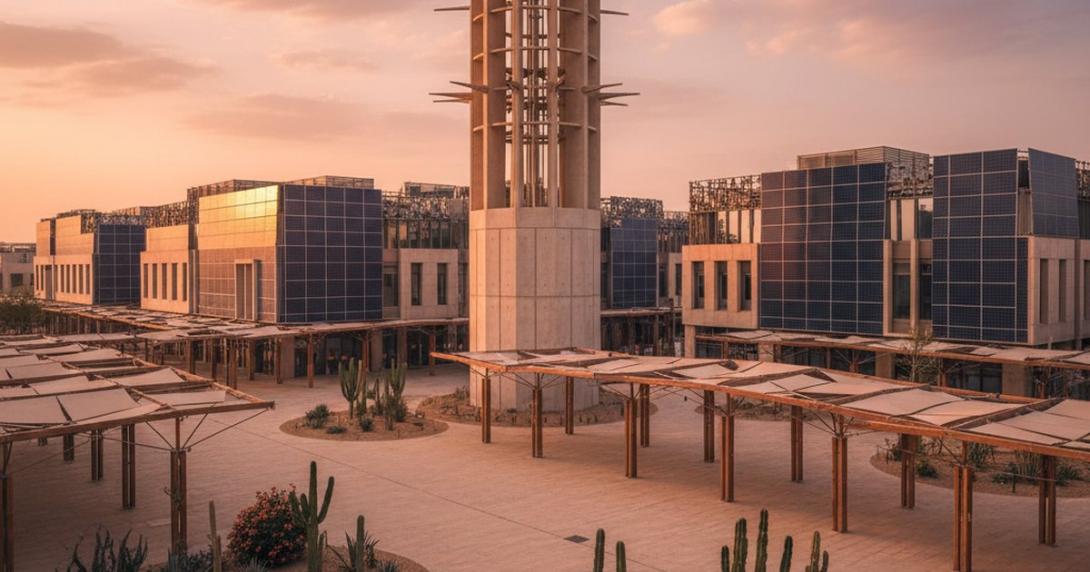
Masdar City is the most-cited piece of the UAE's climate-tech story — a Mubadala-developed sustainable district on the desert edge of Abu Dhabi, masterplanned in 2008 by Foster + Partners as a stand-alone project pitched at the time as the world's first zero-carbon, zero-waste city. The original brief was rolled back as the global solar and battery cost curves moved faster than the original assumptions, and Masdar City repositioned around what it could credibly anchor: a low-carbon, mixed-use cluster pulling in serious tenants. Today it hosts the headquarters of the International Renewable Energy Agency (IRENA), Masdar Clean Energy (Mubadala's renewable-energy arm and one of the world's largest renewable investors), MBZUAI — the world's first AI-focused graduate university — and the regional offices of Siemens and GE Renewable Energy. With the UAE having hosted COP28 in December 2023, Masdar City is the country's main physical answer to "where is the climate-tech ecosystem?"
For broader context, see the business guide hub, the UAE AI ecosystem overview, the growing sectors map, and the business setup primer.
At a Glance
| Field | Detail |
|---|---|
| Type | Sustainable mixed-use development with free zone |
| Developer | Mubadala (via Masdar) |
| Master planner | Foster + Partners |
| Master plan | 2008 |
| Location | Between Abu Dhabi International Airport and central Abu Dhabi |
| Distance from central AD | ~17 km (~25 minutes by car) |
| Free zone status | Masdar City Free Zone, operational since ~2014 |
| Foreign ownership | 100% |
| Corporate tax | 0% on qualifying income (subject to QFZP conditions) |
| Anchor tenants | IRENA HQ, Masdar Clean Energy, MBZUAI, Siemens UAE, GE Renewable Energy MENA |
| Phase 1 community | ~2,000 residents, 4,000+ workers |
| Focus sectors | Renewable energy, sustainability, AI, biotech, clean tech |
| Architecture signature | Masdar Institute Knowledge Centre (windcatcher building) |
What is Masdar City
Masdar City is a sustainable mixed-use development in Abu Dhabi, commissioned by Mubadala through its subsidiary Masdar (Abu Dhabi Future Energy Company). The master plan was published in 2008 by Foster + Partners with a target footprint of roughly 6 km². The original framing — the world's first zero-carbon, zero-waste city — helped position Abu Dhabi as a serious climate actor before clean-tech became a sovereign-strategy fixture.
The original ambition did not survive contact with the 2008 financial crisis or the falling cost curves of solar PV, batteries, and electric mobility through the 2010s. Several signature elements — the city-wide personal rapid transit (PRT) pod network, the wholesale ban on private cars, and the zero-carbon endpoint — were scaled back. Masdar's public framing today is a "low-carbon" or "carbon-positive" cluster: ambitious but pragmatic. What did get built is real, and the cluster effect around climate tech and AI is genuine.
Anchor Tenants
The strength of Masdar City is its tenant roster rather than its real-estate footprint. Five anchors define the place.
IRENA — International Renewable Energy Agency. IRENA is the global intergovernmental body for renewable energy, with 160+ member states. After a competitive global selection process, Abu Dhabi was confirmed as IRENA's permanent host nation and the Masdar City headquarters opened in 2015. The HQ building is a four-storey low-energy structure designed to LEED Platinum standards. Hosting IRENA was the single most important external validation of Masdar City as a climate-tech address.
Masdar Clean Energy. Masdar — formally Abu Dhabi Future Energy Company — is the Mubadala-owned renewable-energy company that both develops Masdar City and operates one of the world's largest renewables portfolios, with active and committed projects exceeding 30 GW across solar, wind, and storage in the UAE, Europe, the US, central Asia, and Africa. An IPO has been mooted multiple times; as of 2024 it has not been executed, with TAQA, Mubadala, and ADNOC Clean Energy holding the equity stack.
MBZUAI — Mohamed bin Zayed University of Artificial Intelligence. Opened in 2020 within the Masdar City campus, MBZUAI is the world's first graduate-only research university dedicated to artificial intelligence. MSc and PhD programmes in machine learning, computer vision, NLP, and applied AI; full scholarships and stipends; faculty from Carnegie Mellon, MIT, Oxford. See the UAE AI ecosystem overview for the wider G42 / TII / AI71 architecture.
Siemens UAE HQ. Siemens consolidated its UAE corporate headquarters at Masdar City in a flagship low-energy building used as a regional reference project for its own building-management portfolio.
GE Renewable Energy MENA. General Electric's renewable-energy regional office sits at Masdar City alongside a roster of smaller climate-tech tenants, sustainability consultancies, and corporate innovation labs.
The Setting
Masdar City sits between Abu Dhabi International Airport and central Abu Dhabi, roughly 17 km from the city centre. By road it is around 25 minutes from downtown outside peak hours and 5-10 minutes from the airport.
The development is pedestrian-first by design — most car traffic is pushed to underground parking and a peripheral road network, with the surface given over to shaded walkways, courtyards, and squares oriented to capture prevailing breezes. The Masdar Institute Knowledge Centre — the iconic windcatcher building with its tall vertical air-cooling tower — is the most-photographed piece of the district and a working low-tech climate-control demonstration.
The grid is anchored on on-site solar — PV arrays integrated into rooftops, car-park canopies, and a dedicated 10 MW solar PV plant that came online in 2009 and was, at the time, the largest grid-connected solar installation in the Middle East.
What's Built
Masdar City is a real, occupied district — but it is also a partial build-out of the original 2008 master plan, and that distinction matters for anyone using the address as a serious base.
Phase 1 is complete and operational. The published occupancy benchmark is roughly 2,000 residents and 4,000+ workers across the IRENA HQ, Siemens HQ, GE Renewable Energy regional office, MBZUAI campus, Masdar Clean Energy offices, and several mid-rise residential blocks. Retail and F&B exist at a scale appropriate for a 2,000-resident community, not a 40,000-resident new town.
Subsequent phases have continued at a steadier pace through the 2020s, with new commercial blocks, residential plots, and sustainability-themed developments such as battery-storage testing facilities. The city-wide zero-carbon endpoint and the original timetable have been retired in favour of incremental, financially disciplined expansion.
Free Zone Status
Masdar City Free Zone has been operational since around 2014 and is one of Abu Dhabi's three principal free zones alongside ADGM and Khalifa Industrial Zone Abu Dhabi (KIZAD). It offers the standard UAE free-zone package — 100% foreign ownership, 0% corporate tax on qualifying income (subject to Qualifying Free Zone Person (QFZP) substance, qualifying-activity, and audited-accounts conditions), full profit repatriation, and customs-free import-export within the free zone.
Permitted activities are tilted toward Masdar City's positioning: renewable energy, sustainability and ESG consultancy, artificial intelligence and machine learning, biotech and life sciences, and the wider technology stack supporting these verticals. General-trading licences are available but are not the cluster's positioning. For sector context, see the growing sectors map.
Setup costs are typically in the AED 25,000-50,000 range for a basic single-activity licence with limited visa quota, scaling with larger office packages. Actual fees depend on activity count, visa allocation, and office class — flexi-desk, dedicated office, or full-floor. For the broader incorporation framework, see the business setup primer.
Why Pick Masdar City
Four reasons drive most credible Masdar City selections.
Climate-tech network effects. IRENA's secretariat, Masdar Clean Energy's regional teams, Siemens UAE, GE Renewable Energy MENA, and a long tail of consultants mean more renewables conversations happen on this small footprint than anywhere else in the country. For a renewables developer or sustainability advisory, the proximity converts into actual business development at a rate that an IFZA or DMCC address does not.
AI ecosystem on-site. MBZUAI is on the same campus, and the wider UAE AI architecture — G42, TII, AI71, MGX — is mostly in Abu Dhabi. For climate-tech firms whose product depends on optimisation, forecasting, or generative AI applied to physical systems, the talent pipeline is local. See the UAE AI ecosystem overview and the Hub71 profile for the parallel Abu Dhabi startup track.
Carbon-conscious branding. The Masdar City address signals real intent — to investors, government tender desks, and ESG-conscious customers — in a way a generic free-zone address does not. For firms whose go-to-market depends on credibility with sovereign sustainability buyers, that signal is a procurement advantage.
Government commitment post-COP28. The UAE hosted COP28 in December 2023 at Expo City Dubai — physically separate but reinforcing UAE-wide climate-policy momentum, including the USD 30 billion ALTÉRRA climate investment vehicle launched at the same event. Masdar City is the most direct beneficiary of that policy continuity inside Abu Dhabi.
Trade-offs
Three trade-offs are worth weighing before committing.
Distance from central Abu Dhabi. The ~25-minute drive from the city centre is fine for a destination office but inconvenient for staff who want to live close to the corniche, government clients, or the Saadiyat / Yas Island lifestyle clusters. Public transport is limited; most movement in and out is by car or ride-hailing.
Smaller community than DMCC or DIFC. Masdar City Free Zone is a niche cluster of perhaps a few hundred operating tenants — orders of magnitude smaller than DMCC's 25,000+ companies or DIFC's 6,000+. For founders whose value is in cross-sector serendipity (commodities, fintech, retail), the network density is thinner.
Limited retail and lifestyle infrastructure. Phase 1's amenities are appropriate for a 2,000-resident community — adequate, not abundant. Founders accustomed to the Marina or Downtown should treat Masdar City as a place of work rather than a place to live, at least until later phases mature.
Frequently Asked Questions
What is Masdar City?
Masdar City is a sustainable mixed-use development in Abu Dhabi, developed by Mubadala through its subsidiary Masdar. The master plan was published in 2008 by Foster + Partners and originally pitched as the world's first zero-carbon, zero-waste city. Masdar City today is the UAE's main climate-tech and renewable-energy cluster, hosting IRENA's global HQ, Masdar Clean Energy, MBZUAI, Siemens UAE, and GE Renewable Energy MENA.
Is Masdar City carbon-neutral?
Not in the original sense. The 2008 master plan targeted full zero-carbon, zero-waste status, but the scope was rolled back as cost curves evolved. Masdar City today is positioned as a low-carbon or carbon-positive cluster — substantial on-site solar, low-energy buildings, pedestrian-first design, and a tenant roster aligned to climate-tech outcomes — without claiming city-wide carbon-neutral certification.
What is IRENA?
IRENA — the International Renewable Energy Agency — is the global intergovernmental organisation for renewable energy, with 160+ member states. The UAE is IRENA's permanent host nation, and IRENA's headquarters in Masdar City opened in 2015 in a four-storey LEED Platinum building.
Where is MBZUAI located?
MBZUAI — the Mohamed bin Zayed University of Artificial Intelligence — is located inside the Masdar City campus. It is the world's first graduate-only research university dedicated to artificial intelligence, opened in 2020, with full scholarships and faculty from Carnegie Mellon, MIT, and Oxford.
Is Masdar City a free zone?
Yes. Masdar City Free Zone has been operational since around 2014, alongside ADGM as one of Abu Dhabi's principal free zones. It offers 100% foreign ownership, 0% corporate tax on qualifying income (subject to QFZP conditions), and full profit repatriation, positioned for renewable energy, sustainability, AI, biotech, and technology activities.
Who built Masdar City?
Masdar City was commissioned by Mubadala, Abu Dhabi's sovereign investment company, through its subsidiary Masdar (Abu Dhabi Future Energy Company). The 2008 master plan was prepared by Foster + Partners.
What companies are in Masdar City?
The principal anchors are IRENA's global HQ, Masdar Clean Energy, MBZUAI, Siemens UAE, and GE Renewable Energy MENA, alongside several hundred firms in the Masdar City Free Zone — primarily in renewable-energy development, sustainability consultancy, AI and machine learning, biotech, and supporting technology services.
How do I get to Masdar City from Abu Dhabi?
Masdar City sits between Abu Dhabi International Airport and central Abu Dhabi, roughly 17 km from the city centre. By road it is around 25 minutes from downtown outside peak hours and 5-10 minutes from the airport. Most movement is by car or ride-hailing.
Is Masdar City finished?
No — Phase 1 is complete and occupied, but the original master plan has not been fully built out. The Phase 1 benchmark is around 2,000 residents and 4,000+ workers. Subsequent phases continue incrementally; the original city-wide zero-carbon endpoint and timetable have been retired in favour of disciplined expansion.
Can a non-climate-tech company set up in Masdar City?
Yes, but it is not the cluster's positioning. Masdar City Free Zone permits a broad range of activities. The cluster's value, however, is proximity to IRENA, Masdar Clean Energy, MBZUAI, Siemens, and GE Renewable Energy MENA — for founders outside renewables, AI, sustainability, biotech, or adjacent tech, a DMCC, IFZA, ADGM, or DIFC address may be a better fit. See the free zones overview for the wider comparison.
General information based mainly on official public sources, not legal, immigration, tax, financial or medical advice. Rules and fees change: confirm with the relevant authority or a qualified professional before acting. See our Terms of Use.